Scuba diving: Difference between revisions
CSV import |
CSV import |
||
| Line 21: | Line 21: | ||
{{stub}} | {{stub}} | ||
== Scuba_diving == | |||
<gallery> | |||
File:Buzo.jpg|Buzo | |||
File:ScubaDiver.jpg|Scuba Diver | |||
File:Naufragio_por_Gustavo_Gerdel.jpg|Naufragio por Gustavo Gerdel | |||
File:Dykeri,_fig_6,_Nordisk_familjebok.png|Dykeri, fig 6, Nordisk familjebok | |||
File:Henry_Albert_Fleuss.jpg|Henry Albert Fleuss | |||
File:Aqualung_(PSF).png|Aqualung | |||
File:Sidemount_032_Photo_by_Pete_Nawrocky.jpg|Sidemount 032 Photo by Pete Nawrocky | |||
File:Trevor_Jackson_returns_from_SS_Kyogle.jpg|Trevor Jackson returns from SS Kyogle | |||
File:Scuba_Diver_-_Ahmad_Faiz_Mustafa.jpg|Scuba Diver - Ahmad Faiz Mustafa | |||
File:Diving_regualtor_assembly.jpg|Diving regulator assembly | |||
File:Plongee-RecycleurInspiration_20040221-153656.jpg|Plongee-Recycleur Inspiration | |||
File:EANxDecal.png|EANx Decal | |||
</gallery> | |||
Latest revision as of 21:03, 23 February 2025
Scuba diving is a mode of underwater diving where the diver uses a self-contained underwater breathing apparatus (scuba), which is completely independent of surface supply, to breathe underwater. Scuba divers carry their own source of breathing gas, usually compressed air, allowing them greater independence and freedom of movement than surface-supplied divers, and longer underwater endurance than breath-hold divers.
History[edit]
The history of scuba diving is closely linked with the history of scuba equipment. By the turn of the twentieth century, two basic architectures for underwater breathing apparatus had been pioneered; open-circuit surface supplied equipment where the diver's exhaled gas is vented directly into the water, and closed-circuit breathing apparatus where the diver's carbon dioxide is filtered from the inhaled gas, which is then recirculated, which reduces the volume of breathing gas required.
Equipment[edit]
Scuba diving may be done recreationally or professionally in a number of applications, including scientific, military and public safety roles, but most commercial diving uses surface-supplied diving equipment when this is practicable. A scuba diver primarily moves underwater by using fins attached to the feet, but external propulsion can be provided by a diver propulsion vehicle, or a sled pulled from the surface.
Safety[edit]
Scuba diving is relatively high risk compared to many other sports, and requires good physical conditioning and attention to detail. Divers face specific physical and health risks in the water environment due to the scuba equipment itself, as well as the pressure and physiological changes that result from the depth and duration of the dive.
See also[edit]
 | |
|---|---|
 |
 |
Scuba_diving[edit]
-
 Buzo
Buzo -
 Scuba Diver
 -
 Naufragio por Gustavo Gerdel
 -
 Dykeri, fig 6, Nordisk familjebok
 -
 Henry Albert Fleuss
 -
 Aqualung
 -
 Sidemount 032 Photo by Pete Nawrocky
 -
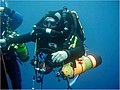 Trevor Jackson returns from SS Kyogle
 -
 Scuba Diver - Ahmad Faiz Mustafa
 -
 Diving regulator assembly
 -
 Plongee-Recycleur Inspiration
 -
 EANx Decal


.png)


