Sidewalk: Difference between revisions
CSV import |
CSV import Tags: mobile edit mobile web edit |
||
| Line 26: | Line 26: | ||
{{stub}} | {{stub}} | ||
{{dictionary-stub1}} | {{dictionary-stub1}} | ||
<gallery> | |||
File:PompeiiStreet.jpg|Pompeii Street | |||
File:E_India_House.jpg|E India House | |||
File:Lower_Ocean_Avenue,_Oakwood_Beach,_Staten_Island,_N.Y._(beach_cottages,_people_walking_on_raised_sidewalk)_(NYPL_b15279351-105077)_(cropped).tiff|Lower Ocean Avenue, Oakwood Beach, Staten Island, N.Y. | |||
File:Old_Bond_Street_1a_db.jpg|Old Bond Street | |||
File:Tampere_-_Kauppakatu.jpg|Tampere - Kauppakatu | |||
File:Sidewalk_with_bike_path.JPG|Sidewalk with bike path | |||
File:Orchard_Road_street_busking.JPG|Orchard Road street busking | |||
File:Brick_sidewalk,_EDS,_Cambridge.jpg|Brick sidewalk, EDS, Cambridge | |||
File:Yeonamyulgeum-ro_Sidewalk_in_Cheonan_City_20270720.jpg|Yeonamyulgeum-ro Sidewalk in Cheonan City | |||
File:Verbanden.png|Verbanden | |||
File:Stone_slab_sidewalk.jpg|Stone slab sidewalk | |||
File:Sidewalk_construction.JPG|Sidewalk construction | |||
</gallery> | |||
Latest revision as of 21:09, 23 February 2025
Sidewalk or pavement is a path designed for pedestrian traffic, usually located at the side of a road. Sidewalks may be used for walking, jogging, and other forms of foot traffic. They are also used by cyclists, skateboarders, and rollerbladers. Sidewalks are typically made of concrete or asphalt, but can also be made of bricks, stones, or other materials.
History[edit]
The concept of the sidewalk has been around for thousands of years. The earliest known sidewalks were found in ancient cities such as Pompeii and Ephesus, where they were used to separate pedestrians from the dirt and mud of the streets. In the Middle Ages, sidewalks were often built in front of houses to provide a clean path for pedestrians. The modern sidewalk, as we know it today, began to take shape in the 19th century, when cities began to pave their streets with asphalt or concrete.
Design and construction[edit]
The design and construction of sidewalks vary greatly depending on the location and the intended use. In urban areas, sidewalks are often wider to accommodate more foot traffic. They may also have features such as benches, trees, and street lights. In rural areas, sidewalks may be narrower or non-existent. The construction of a sidewalk involves several steps, including site preparation, formwork, pouring and finishing the concrete, and curing.
Maintenance and repair[edit]
Sidewalks require regular maintenance to keep them safe and usable. This includes cleaning, snow removal, and repair of any damage. Damage to sidewalks can be caused by a variety of factors, including weather, tree roots, and heavy use. Repair methods may include patching, resurfacing, or complete replacement.
Accessibility[edit]
Sidewalks play a crucial role in providing accessibility for people with disabilities. Features such as curb ramps, tactile paving, and adequate width are important for ensuring that sidewalks are accessible to all users.
See also[edit]
 | |
|---|---|
 |
 |
-
 Pompeii Street
 -
 E India House
 -
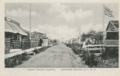 Lower Ocean Avenue, Oakwood Beach, Staten Island, N.Y.
 -
 Old Bond Street
 -
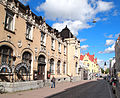 Tampere - Kauppakatu
 -
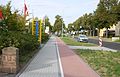 Sidewalk with bike path
 -
 Orchard Road street busking
 -
 Brick sidewalk, EDS, Cambridge
 -
 Yeonamyulgeum-ro Sidewalk in Cheonan City
 -
 Verbanden
 -
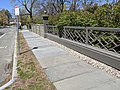 Stone slab sidewalk
 -
 Sidewalk construction


