Salamander: Difference between revisions
CSV import Tags: mobile edit mobile web edit |
CSV import |
||
| Line 27: | Line 27: | ||
{{stub}} | {{stub}} | ||
{{dictionary-stub1}} | {{dictionary-stub1}} | ||
<gallery> | |||
File:SpottedSalamander.jpg|Spotted Salamander | |||
File:Salamandra_lanzai13.jpg|Salamandra lanzai | |||
File:S_lacertina_USGS.jpg|Siren lacertina | |||
File:Taricha_granulosa_(Rough-skinned_newt).JPG|Rough-skinned Newt | |||
File:P_anguinus-head1.jpg|Proteus anguinus | |||
File:Biofluorescent_patterns_across_salamander_diversity_and_anatomy_-_41598_2020_59528_Fig1.jpg|Biofluorescent Patterns in Salamanders | |||
File:Salamander_-QDB.JPG|Salamander | |||
File:Levatores_arcuum_of_Necturus_maculosus.png|Necturus maculosus | |||
File:Salamander_head.png|Salamander Head | |||
File:Salamander-olympus.jpg|Salamander Olympus | |||
File:US-CA-NevadaCity-NewtAmplexus.jpg|Newt Amplexus | |||
File:Embryonic_development_of_a_salamander,_filmed_in_the_1920s.ogv|Embryonic Development of a Salamander | |||
</gallery> | |||
Latest revision as of 21:12, 23 February 2025
Salamander is a group of approximately 500 species of amphibians typically characterized by a lizard-like appearance, with slender bodies, blunt snouts, short limbs projecting at right angles to the body, and the presence of a tail in both larvae and adults.
Classification[edit]
Salamanders are part of the order Urodela, which also includes newts. The order is divided into nine families, with a diverse range of species and habitats.
Anatomy and Morphology[edit]
Salamanders range in size from the minute salamanders, with a total length of 2.7 cm (1.1 in), including the tail, to the Chinese giant salamander which reaches 1.8 m (5.9 ft) and weighs up to 65 kg (143 lb).
Habitat and Distribution[edit]
Salamanders are found in most parts of the world but are most numerous in the Northern Hemisphere. Many species are aquatic, but some are terrestrial, and some are capable of both modes of locomotion.
Behavior and Ecology[edit]
Salamanders are capable of regenerating lost limbs, as well as other damaged parts of their bodies. Researchers hope to reverse engineer the remarkable regenerative processes for potential human medical applications, such as in limb regeneration.
Conservation[edit]
Many species of salamanders are endangered, and some are threatened with extinction, due to habitat loss, pollution, disease, and other factors.
See Also[edit]
 | |
|---|---|
 |
 |
-
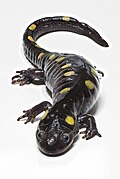 Spotted Salamander
 -
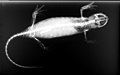 Salamandra lanzai
 -
 Siren lacertina
 -
 Rough-skinned Newt
 -
 Proteus anguinus
 -
 Biofluorescent Patterns in Salamanders
 -
 Salamander
 -
 Necturus maculosus
 -
 Salamander Head
 -
 Salamander Olympus
 -
 Newt Amplexus
 -
 Embryonic Development of a Salamander


.JPG)


