Unicellular organism: Difference between revisions
CSV import Tags: mobile edit mobile web edit |
CSV import |
||
| Line 1: | Line 1: | ||
{{short description|Organisms consisting of a single cell}} | |||
{{Use dmy dates|date=October 2023}} | |||
'''Unicellular organisms''' are organisms that consist of a single [[cell (biology)|cell]], unlike [[multicellular organism|multicellular organisms]] which are made up of multiple cells. Unicellular organisms can be either [[prokaryote|prokaryotic]] or [[eukaryote|eukaryotic]]. | |||
Unicellular | ==Types of Unicellular Organisms== | ||
== | ===Prokaryotes=== | ||
Prokaryotic unicellular organisms include [[bacteria]] and [[archaea]]. These organisms lack a [[cell nucleus|nucleus]] and other membrane-bound organelles. Bacteria are found in virtually every habitat on Earth, from soil to water to the human body. Archaea, although similar in appearance to bacteria, have distinct genetic and biochemical characteristics. | |||
===Eukaryotes=== | |||
Eukaryotic unicellular organisms include [[protists]], [[algae]], and some [[fungi]]. These organisms have a nucleus and other organelles enclosed within membranes. Examples include the [[Paramecium]], a type of [[ciliate]], and various species of [[unicellular algae]] such as [[diatoms]]. | |||
== Reproduction == | ==Reproduction== | ||
Unicellular organisms reproduce in various ways, including [[binary fission]], [[budding]], and [[spore]] formation. In binary fission, the cell divides into two genetically identical cells. Budding involves the formation of a new organism from a small projection on the parent organism. Some unicellular organisms can also exchange genetic material through processes such as [[conjugation (biology)|conjugation]]. | |||
Unicellular organisms | ==Ecological Role== | ||
Unicellular organisms play crucial roles in ecosystems. They are primary producers in many aquatic environments, forming the base of the food web. They also contribute to the [[nitrogen cycle]] and other biogeochemical cycles. Some unicellular organisms are pathogens, causing diseases in humans, animals, and plants. | |||
== | ==Evolutionary Significance== | ||
Unicellular organisms are believed to be the earliest forms of life on Earth. Fossil evidence, such as [[stromatolites]], suggests that unicellular life existed over 3.5 billion years ago. These organisms have evolved into a wide variety of forms, leading to the diversity of life seen today. | |||
==Gallery== | |||
<gallery> | |||
File:Ventricaria_ventricosa.JPG|''[[Ventricaria ventricosa]]'', a large unicellular alga | |||
File:Stromatolites_in_Sharkbay.jpg|[[Stromatolites]] in Shark Bay, Western Australia | |||
File:Bacteria_with_capsule.jpg|[[Bacteria]] with a capsule | |||
File:Echinoderms_600.jpg|[[Echinoderm]] larvae, an example of a multicellular organism | |||
File:Paramecia_tetraurelia.jpeg|''[[Paramecium tetraurelia]]'', a ciliate | |||
File:CSIRO_ScienceImage_7632_SEM_diatom.jpg|[[Diatom]], a type of unicellular algae | |||
File:Kg3.jpg|[[Yeast]], a unicellular fungus | |||
</gallery> | |||
== | ==Related pages== | ||
* [[Multicellular organism]] | * [[Multicellular organism]] | ||
* [[ | * [[Prokaryote]] | ||
* [[ | * [[Eukaryote]] | ||
* [[Microorganism]] | |||
== References == | ==References== | ||
* Madigan, M.T., Martinko, J.M., Bender, K.S., Buckley, D.H., & Stahl, D.A. (2014). ''Brock Biology of Microorganisms''. Pearson. | |||
* Margulis, L., & Schwartz, K.V. (1998). ''Five Kingdoms: An Illustrated Guide to the Phyla of Life on Earth''. W.H. Freeman. | |||
[[Category:Unicellular organisms]] | [[Category:Unicellular organisms]] | ||
Revision as of 00:33, 10 February 2025
Organisms consisting of a single cell
Unicellular organisms are organisms that consist of a single cell, unlike multicellular organisms which are made up of multiple cells. Unicellular organisms can be either prokaryotic or eukaryotic.
Types of Unicellular Organisms
Prokaryotes
Prokaryotic unicellular organisms include bacteria and archaea. These organisms lack a nucleus and other membrane-bound organelles. Bacteria are found in virtually every habitat on Earth, from soil to water to the human body. Archaea, although similar in appearance to bacteria, have distinct genetic and biochemical characteristics.
Eukaryotes
Eukaryotic unicellular organisms include protists, algae, and some fungi. These organisms have a nucleus and other organelles enclosed within membranes. Examples include the Paramecium, a type of ciliate, and various species of unicellular algae such as diatoms.
Reproduction
Unicellular organisms reproduce in various ways, including binary fission, budding, and spore formation. In binary fission, the cell divides into two genetically identical cells. Budding involves the formation of a new organism from a small projection on the parent organism. Some unicellular organisms can also exchange genetic material through processes such as conjugation.
Ecological Role
Unicellular organisms play crucial roles in ecosystems. They are primary producers in many aquatic environments, forming the base of the food web. They also contribute to the nitrogen cycle and other biogeochemical cycles. Some unicellular organisms are pathogens, causing diseases in humans, animals, and plants.
Evolutionary Significance
Unicellular organisms are believed to be the earliest forms of life on Earth. Fossil evidence, such as stromatolites, suggests that unicellular life existed over 3.5 billion years ago. These organisms have evolved into a wide variety of forms, leading to the diversity of life seen today.
Gallery
-
 Ventricaria ventricosa, a large unicellular alga
 -
 Stromatolites in Shark Bay, Western Australia
 -
 Bacteria with a capsule
 -
 Echinoderm larvae, an example of a multicellular organism
 -
 Paramecium tetraurelia, a ciliate
 -
 Diatom, a type of unicellular algae
 -
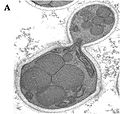 Yeast, a unicellular fungus


Related pages
References
- Madigan, M.T., Martinko, J.M., Bender, K.S., Buckley, D.H., & Stahl, D.A. (2014). Brock Biology of Microorganisms. Pearson.
- Margulis, L., & Schwartz, K.V. (1998). Five Kingdoms: An Illustrated Guide to the Phyla of Life on Earth. W.H. Freeman.
