Toilet: Difference between revisions
CSV import |
CSV import Tags: mobile edit mobile web edit |
||
| Line 35: | Line 35: | ||
{{stub}} | {{stub}} | ||
<gallery> | |||
File:Toilet_photo.jpg|Toilet photo | |||
File:Squat-toilet-with-tank.jpg|Squat toilet with tank | |||
File:Raised_pit_toilet,_Informal_settlements_Kampala_(8409884995).jpg|Raised pit toilet, Informal settlements Kampala | |||
File:Defecating_into_a_pit_(schematic).jpg|Defecating into a pit (schematic) | |||
File:Toilet_370x580.jpg|Toilet 370x580 | |||
File:Twin_Pits_for_Pour_Flush_diagram.svg|Twin Pits for Pour Flush diagram | |||
File:Vacuum_toilet_in_a_train.jpg|Vacuum toilet in a train | |||
File:Dolmabahce_Toilette2.jpg|Dolmabahce Toilette | |||
File:Lower_NTK_Estate_old_squat_toilet.jpg|Lower NTK Estate old squat toilet | |||
File:French_Squatter_Toilet.jpg|French Squatter Toilet | |||
File:Squattoilet.jpg|Squat toilet | |||
</gallery> | |||
Latest revision as of 21:42, 23 February 2025
Toilet is a sanitation fixture used primarily for the disposal of human excrement and urine, often found in a small room referred to as a toilet/bathroom/lavatory. Toilets can be with or without flushing water (flush toilet or dry toilet). They can be set up for a sitting posture or for a squatting posture (squat toilet). Flush toilets are usually connected to a sewer system in urban areas and to septic tanks in less built-up areas.
History[edit]
The history of toilets and sanitation is a fascinating subject that relates to important aspects of human civilization. The earliest known toilets that used water to remove waste are from the 3rd millennium BC in the Indus Valley Civilization. In ancient Rome, communal public toilets were a feature of daily life. In the Middle Ages, formal garderobes were used in castles and other upper-class dwellings.
Types of Toilets[edit]
There are several types of toilets used worldwide, but they generally fall into the following types:
- Flush toilets: These are connected to a sewer system or septic tank. The waste is flushed with water from a cistern.
- Dry toilets: These do not use water for flushing. Instead, they use a removable container, composting, or incineration to manage waste.
- Chemical toilets: These use chemicals to deodorize waste. They are often used in settings where it is impractical to install a flush toilet.
- Composting toilets: These use the natural processes of decomposition and evaporation to recycle human waste.
Health Aspects[edit]
Toilets, sanitation, and hygiene are critical to human health. The lack of access to toilets is a major health issue in many parts of the world. The World Health Organization (WHO) estimates that nearly 2.3 billion people do not have access to basic sanitation facilities such as toilets or latrines.
Environmental Aspects[edit]
Toilets also have significant environmental implications. The flushing of toilets and the processing of human waste can be a major source of water pollution. Composting toilets and other eco-friendly toilet technologies are being developed to address these issues.
See Also[edit]
 | This medical article is a stub. You can help WikiMD by expanding the page. |
-
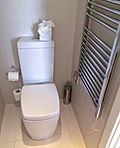 Toilet photo
 -
 Squat toilet with tank
 -
 Raised pit toilet, Informal settlements Kampala
 -
 Defecating into a pit (schematic)
 -
 Toilet 370x580
 -
 Twin Pits for Pour Flush diagram
 -
 Vacuum toilet in a train
 -
 Dolmabahce Toilette
 -
 Lower NTK Estate old squat toilet
 -
 French Squatter Toilet
 -
 Squat toilet


.jpg)
.jpg)


