Nuchal cord: Difference between revisions
CSV import |
CSV import |
||
| Line 23: | Line 23: | ||
{{stub}} | {{stub}} | ||
<gallery> | |||
File:Tab_IX;_Foetus_in_utero_with_umbilical_cord_wrapped_Wellcome_L0064782_(cropped).jpg|Foetus in utero with umbilical cord wrapped | |||
File:SubConjNuchal.gif|Subconjunctival hemorrhage due to nuchal cord | |||
File:PetechiaNuchal.gif|Petechiae due to nuchal cord | |||
File:FacialDusky.gif|Facial dusky appearance due to nuchal cord | |||
File:AbrasionNuchal.gif|Abrasion due to nuchal cord | |||
File:USNuchal.gif|Ultrasound showing nuchal cord | |||
File:NuchalFree.gif|Nuchal cord free | |||
File:NuchalLocked.gif|Nuchal cord locked | |||
</gallery> | |||
Revision as of 11:33, 18 February 2025
Nuchal cord is a medical condition that occurs when the umbilical cord wraps around the fetus' neck 360 degrees. This condition is relatively common and can occur during pregnancy, labor, or birth.
Causes
The exact cause of a nuchal cord is not known. However, it is believed to be related to the movements of the fetus within the womb. The umbilical cord, which connects the fetus to the mother's placenta, can become wrapped around the fetus' neck as it moves and turns.
Diagnosis
A nuchal cord can be diagnosed during pregnancy through an ultrasound examination. However, it is often not detected until birth. During labor, a healthcare provider may suspect a nuchal cord if there are changes in the baby's heart rate.
Treatment
In most cases, a nuchal cord is not a cause for concern and does not require treatment. During birth, the healthcare provider can usually slip the cord over the baby's head or clamp and cut the cord before the baby is delivered. In some cases, a Cesarean section may be necessary.
Complications
While a nuchal cord is usually harmless, it can sometimes lead to complications. These can include decreased blood flow to the baby, which can lead to a lower heart rate. In rare cases, a nuchal cord can cause stillbirth.
See also
 | This medical article is a stub. You can help WikiMD by expanding the page. |
-
 Foetus in utero with umbilical cord wrapped
 -
 Subconjunctival hemorrhage due to nuchal cord
 -
 Petechiae due to nuchal cord
 -
 Facial dusky appearance due to nuchal cord
 -
 Abrasion due to nuchal cord
 -
 Ultrasound showing nuchal cord
 -
 Nuchal cord free
 -
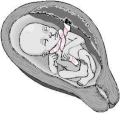 Nuchal cord locked
.jpg)


