Mycobacterium: Difference between revisions
CSV import |
CSV import |
||
| Line 24: | Line 24: | ||
{{stub}} | {{stub}} | ||
<gallery> | |||
File:Mycobacterium_tuberculosis_01.jpg|Mycobacterium tuberculosis 01 | |||
File:Model_of_the_Mycobacterial_Cell_Envelope.png|Model of the Mycobacterial Cell Envelope | |||
File:Three_Pathogenic_Mycobacteria.png|Three Pathogenic Mycobacteria | |||
File:Phylogentic_Tree_of_Slowly-Growing_Mycobacterium_Tortoli_2017.png|Phylogenetic Tree of Slowly-Growing Mycobacterium Tortoli 2017 | |||
File:Phylogentic_Tree_of_Rapidly-Growing_Mycobacterium_Tortoli_2017.png|Phylogenetic Tree of Rapidly-Growing Mycobacterium Tortoli 2017 | |||
File:Mycobacterium_tuberculosis_Ziehl-Neelsen_stain_02.jpg|Mycobacterium tuberculosis Ziehl-Neelsen stain 02 | |||
File:Slant_tubes_of_Löwenstein-Jensen_medium_with_control,_M_tuberculosis,_M_avium_and_M_gordonae.jpg|Slant tubes of Löwenstein-Jensen medium with control, M tuberculosis, M avium and M gordonae | |||
File:Mycobacteria_Growth_Indicator_Tube_(MGIT)_samples_in_ultraviolet_light.jpg|Mycobacteria Growth Indicator Tube (MGIT) samples in ultraviolet light | |||
</gallery> | |||
Latest revision as of 21:10, 23 February 2025
Mycobacterium is a genus of Actinobacteria, given its own family, the Mycobacteriaceae. The genus includes pathogens known to cause serious diseases in mammals, including tuberculosis (Mycobacterium tuberculosis) and leprosy (Mycobacterium leprae). The Greek prefix myco- means "fungus," alluding to the way mycobacteria have been observed to grow in a mold-like fashion on the surface of cultures. It is acid-fast and has an unusually high lipid content.
Characteristics[edit]
Mycobacteria are aerobic and nonmotile bacteria (except for the species Mycobacterium marinum, which has been shown to be motile within macrophages) that are characteristically acid-alcohol fast. Mycobacteria have an outer membrane lipid bilayer. If a Gram stain is performed, they will stain very weakly Gram-positive or may not retain dye due to the high lipid and mycolic acid content of their cell walls.
Pathogenesis[edit]
Mycobacteria can colonize their hosts without the hosts showing any adverse signs. For example, billions of humans around the world are infected with Mycobacterium tuberculosis, but have no symptoms due to it being a latent infection. The host's immune system is unable to completely clear the organism, and the bacteria can survive in a dormant state within the host for years.
Species[edit]
There are over 150 recognized species of Mycobacterium, some of which are pathogenic. The best known pathogenic species are M. tuberculosis and M. leprae. Other known pathogenic species include M. avium and M. bovis.
Treatment[edit]
Treatment varies by the species of Mycobacterium involved. For example, M. tuberculosis is typically treated with a regimen of multiple antibiotics to reduce the risk of the bacteria developing antibiotic resistance. M. leprae is also treated with a combination of antibiotics.
See also[edit]
 | This medical article is a stub. You can help WikiMD by expanding the page. |
-
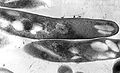 Mycobacterium tuberculosis 01
 -
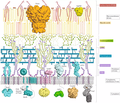 Model of the Mycobacterial Cell Envelope
 -
 Three Pathogenic Mycobacteria
 -
 Phylogenetic Tree of Slowly-Growing Mycobacterium Tortoli 2017
 -
 Phylogenetic Tree of Rapidly-Growing Mycobacterium Tortoli 2017
 -
 Mycobacterium tuberculosis Ziehl-Neelsen stain 02
 -
 Slant tubes of Löwenstein-Jensen medium with control, M tuberculosis, M avium and M gordonae
 -
 Mycobacteria Growth Indicator Tube (MGIT) samples in ultraviolet light


_samples_in_ultraviolet_light.jpg)
