Levator palpebrae superioris muscle: Difference between revisions
CSV import |
CSV import |
||
| Line 23: | Line 23: | ||
{{Muscle-stub}} | {{Muscle-stub}} | ||
{{dictionary-stub1}} | {{dictionary-stub1}} | ||
<gallery> | |||
File:Gray891.png|Levator palpebrae superioris muscle | |||
File:Gray893.png|Levator palpebrae superioris muscle | |||
File:Trochlear_and_frontal_nerves.jpg|Levator palpebrae superioris muscle | |||
File:Slide16aa.JPG|Levator palpebrae superioris muscle | |||
File:Slide1abaa.JPG|Levator palpebrae superioris muscle | |||
File:Slide3abab.JPG|Levator palpebrae superioris muscle | |||
</gallery> | |||
Latest revision as of 05:03, 18 February 2025
Levator palpebrae superioris muscle is a muscle in the orbit that elevates the superior (upper) eyelid. It is innervated by the oculomotor nerve (cranial nerve III).
Structure[edit]
The levator palpebrae superioris originates on the lesser wing of the sphenoid bone, just above the optic foramen. It broadens and becomes thinner and forms a broad, flat tendon, which inserts onto the superior tarsal plate of the upper eyelid. It is a skeletal muscle, and has a smooth muscle component, the superior tarsal muscle, which is sympathetically innervated.
Function[edit]
The primary function of the levator palpebrae superioris is to elevate the upper eyelid. The smooth muscle component, the superior tarsal muscle, when stimulated by the sympathetic nervous system, will cause a more sustained eyelid elevation.
Clinical significance[edit]
Damage to this muscle or its innervation can cause ptosis, which is drooping of the eyelid. This can be caused by damage to the oculomotor nerve, or damage to the sympathetic supply to the superior tarsal muscle.
See also[edit]
References[edit]
<references />


-
 Levator palpebrae superioris muscle
 -
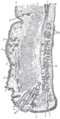 Levator palpebrae superioris muscle
 -
 Levator palpebrae superioris muscle
 -
 Levator palpebrae superioris muscle
 -
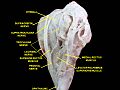 Levator palpebrae superioris muscle
 -
 Levator palpebrae superioris muscle


