Leukoencephalopathy with neuroaxonal spheroids: Difference between revisions
From WikiMD's Medical Encyclopedia
CSV import |
CSV import |
||
| Line 54: | Line 54: | ||
{{nervoussystem-disease-stub}} | {{nervoussystem-disease-stub}} | ||
{{dictionary-stub1}} | {{dictionary-stub1}} | ||
<gallery> | |||
File:Neuron_with_oligodendrocyte_and_myelin_sheath-2.svg|Neuron with oligodendrocyte and myelin sheath | |||
File:Missense_Mutation_Example.jpg|Missense mutation example | |||
File:Lobes_of_the_brain.jpg|Lobes of the brain | |||
File:1511_The_Limbic_Lobe.jpg|The limbic lobe | |||
File:White_Matter_Lesions_(48601156232).jpg|White matter lesions | |||
File:Blausen_0617_LumbarPuncture.png|Lumbar puncture | |||
File:Stem_cell_differentiation.svg|Stem cell differentiation | |||
</gallery> | |||
Latest revision as of 11:47, 18 February 2025
| Leukoencephalopathy with neuroaxonal spheroids | |
|---|---|

| |
| Synonyms | |
| Pronounce | |
| Field | neurology |
| Symptoms | |
| Complications | |
| Onset | |
| Duration | |
| Types | |
| Causes | |
| Risks | |
| Diagnosis | |
| Differential diagnosis | |
| Prevention | |
| Treatment | |
| Medication | |
| Prognosis | |
| Frequency | |
| Deaths | |
Leukoencephalopathy with neuroaxonal spheroids is a special kind of leukoencephalopathy. It is a cause of severe and subacute dementia. It is inherited, following an autosomal dominant pattern.
It usually presents in childhood but it can also have an adult onset,<ref>,
 Adult-onset leukoencephalopathy with axonal spheroids and pigmented glia (ALSP): Integrating the literature on hereditary diffuse leukoencephalopathy with spheroids (HDLS) and pigmentary orthochromatic leukodystrophy (POLD),
 Journal of Clinical Neuroscience,

 Vol. 48(Issue: 1),
 pp. 42–49,
 DOI: 10.1016/j.jocn.2017.10.060,
 PMID: 29122458,</ref> in which case it can present MRIs that mimic those of progressive multiple sclerosis.<ref>,
 Sporadic adult-onset leukoencephalopathy with neuroaxonal spheroids mimicking cerebral MS,
 Neurology,

 Vol. 70(Issue: 13 Pt 2),
 pp. 1128–33,
 DOI: 10.1212/01.wnl.0000304045.99153.8f,
 PMID: 18287567,</ref>
See also[edit]
References[edit]
External links[edit]
_(14784117803).jpg)

-
 Neuron with oligodendrocyte and myelin sheath
 -
 Missense mutation example
 -
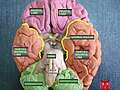 Lobes of the brain
 -
 The limbic lobe
 -
 White matter lesions
 -
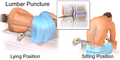 Lumbar puncture
 -
 Stem cell differentiation


.jpg)


