Oxygen therapy: Difference between revisions
CSV import |
CSV import |
||
| Line 22: | Line 22: | ||
{{stub}} | {{stub}} | ||
{{dictionary-stub1}} | {{dictionary-stub1}} | ||
<gallery> | |||
File:Simple_face_mask.jpg|Simple face mask used for oxygen therapy | |||
File:Oxygen_piping.png|Oxygen piping system in a hospital | |||
File:o2regulator.JPG|Oxygen regulator for controlling flow | |||
File:Home_oxygen_canisters.jpg|Home oxygen canisters for personal use | |||
File:Home_oxygen_concentrator.jpg|Home oxygen concentrator device | |||
File:Nasalprongs.JPG|Nasal prongs for delivering oxygen | |||
File:NRBer.JPG|Non-rebreather mask for high concentration oxygen delivery | |||
File:o2regulator.JPG|Oxygen regulator for controlling flow | |||
</gallery> | |||
Latest revision as of 11:16, 18 February 2025
Oxygen therapy is the administration of oxygen as a medical intervention, which can be for a variety of purposes in both chronic and acute patient care. Oxygen is essential for cell metabolism, and in turn, tissue oxygenation is essential for all normal physiological functions.
High levels of oxygen[edit]
High levels of oxygen are given to individuals who have low levels of oxygen in their blood. This can be due to conditions such as chronic obstructive pulmonary disease (COPD), pneumonia, a severe asthma attack, late-stage heart failure, and cystic fibrosis.
Administration[edit]
Oxygen can be administered in several ways, including nasal cannula, face mask, and inside a hyperbaric chamber. The method of administration can depend on the patient's condition and preference.
Risks[edit]
While oxygen therapy can have many benefits, it can also have risks. These can include dry or bloody nose, tiredness, and in some cases, oxygen toxicity.
See also[edit]
References[edit]
<references />
 | |
|---|---|
 |
 |
-
 Simple face mask used for oxygen therapy
 -
 Oxygen piping system in a hospital
 -
 Oxygen regulator for controlling flow
 -
 Home oxygen canisters for personal use
 -
 Home oxygen concentrator device
 -
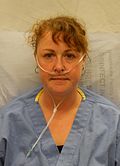 Nasal prongs for delivering oxygen
 -
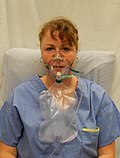 Non-rebreather mask for high concentration oxygen delivery
 -
Oxygen regulator for controlling flow


