Ricciarelli: Difference between revisions
CSV import |
CSV import |
||
| Line 38: | Line 38: | ||
* ''The Food of Italy'', Claudia Roden, Alfred A. Knopf, 1996. | * ''The Food of Italy'', Claudia Roden, Alfred A. Knopf, 1996. | ||
{{dictionary-stub1}} | {{dictionary-stub1}} | ||
<gallery> | |||
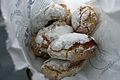
File:Ricciarelli from Siena-2.jpg|Ricciarelli | |||
</gallery> | |||
Latest revision as of 01:45, 20 February 2025
Ricciarelli[edit]
Ricciarelli are traditional Italian almond cookies that originated in the city of Siena. They are a popular treat during the holiday season, particularly during Christmas and Easter. The cookies are soft, chewy, and often covered in powdered sugar.
History[edit]
The history of Ricciarelli dates back to the 14th century. It is believed that they were introduced to Siena by Ricciardetto della Gherardesca upon his return from the Crusades. The cookies were a luxury item, enjoyed by the nobility and used as a form of currency.
Ingredients and Preparation[edit]
The main ingredients in Ricciarelli are almond flour, sugar, and egg whites. Some recipes also include honey, vanilla extract, and orange zest for added flavor. The dough is typically shaped into diamonds or ovals before being baked.
To prepare Ricciarelli, the almond flour and sugar are first combined in a bowl. The egg whites are then beaten until they form stiff peaks and are folded into the almond mixture. The dough is shaped and placed on a baking sheet, then baked until lightly golden.
Variations[edit]
There are several variations of Ricciarelli. Some recipes include additional flavors such as chocolate or lemon zest. There are also variations in the shape and size of the cookies, with some being larger and flatter, while others are smaller and more rounded.
Serving and Storage[edit]
Ricciarelli are typically served with a glass of Vin Santo, a sweet Italian dessert wine. They can be stored in an airtight container for up to two weeks.
Cultural Significance[edit]
Ricciarelli are a significant part of Italian culture, particularly in Siena where they originated. They are often given as gifts during the holiday season and are a staple in many Italian homes during Christmas and Easter.
See Also[edit]
References[edit]
- The Oxford Companion to Sugar and Sweets, Oxford University Press, 2015.
- The Italian Baker, Carol Field, Harper & Row, 1985.
- The Food of Italy, Claudia Roden, Alfred A. Knopf, 1996.

-
 Ricciarelli

