Infrared: Difference between revisions
CSV import |
CSV import |
||
| Line 31: | Line 31: | ||
{{stub}} | {{stub}} | ||
{{dictionary-stub1}} | {{dictionary-stub1}} | ||
==Infrared== | |||
<gallery> | |||
File:Ir_girl.png|Ir girl | |||
File:Wide-field_Infrared_Survey_Explorer_first-light_image.jpg|Wide-field Infrared Survey Explorer first light image | |||
File:Atmosfaerisk_spredning-en.svg|Atmosfaerisk spredning | |||
File:Effect_of_emissivity_on_apparent_temperature.jpg|Effect of emissivity on apparent temperature | |||
File:Active-Infrared-Night-Vision.jpg|Active Infrared Night Vision | |||
File:STS-3_infrared_on_reentry.jpg|STS-3 infrared on reentry | |||
File:Specim_aisaowl_outdoor.png|Specim aisaowl outdoor | |||
File:Blue_infrared_light.jpg|Blue infrared light | |||
File:Infrared_portrait_comparison.jpg|Infrared portrait comparison | |||
File:Hooded_dryer_for_infrared_hair_drying_at_hair_salon_-_shown_from_three_perspectives.jpg|Hooded dryer for infrared hair drying at hair salon - shown from three perspectives | |||
File:NOAA_Shares_First_Infrared_Imagery_from_GOES-17_(43904870711).gif|NOAA Shares First Infrared Imagery from GOES-17 | |||
File:Greenhouse-effect-t2.svg|Greenhouse effect | |||
</gallery> | |||
Latest revision as of 21:23, 23 February 2025
Infrared (IR) is a type of electromagnetic radiation that is invisible to the human eye but can be felt as heat. It is a form of light that has a longer wavelength than visible light, making it invisible to the naked eye. Infrared radiation is used in a variety of applications, including night vision, thermal imaging, and remote sensing.
Overview[edit]
Infrared radiation is a type of electromagnetic radiation, which also includes radio waves, microwaves, and visible light. The term "infrared" means "below red", referring to its position in the electromagnetic spectrum below the color red. Infrared radiation has wavelengths ranging from about 700 nanometers to 1 millimeter.
Applications[edit]
Infrared radiation has a wide range of applications in various fields. Some of the most common uses of infrared include:
- Thermal imaging: Infrared radiation is used in thermal imaging devices to detect heat emitted by objects or beings. This is useful in a variety of fields, including law enforcement, military, and wildlife observation.
- Remote sensing: Infrared radiation is used in remote sensing technologies to detect and measure objects from a distance. This is commonly used in weather forecasting, geology, and astronomy.
- Night vision: Infrared radiation is used in night vision devices to enable visibility in low-light conditions. This is commonly used in military operations, surveillance, and wildlife observation.
Health effects[edit]
Exposure to infrared radiation can have both beneficial and harmful effects on human health. On one hand, infrared radiation is used in physical therapy to provide deep heating to treat conditions such as muscle pain and arthritis. On the other hand, excessive exposure to infrared radiation can cause thermal burns and eye damage.
See also[edit]
 | |
|---|---|
 |
 |
Infrared[edit]
-
 Ir girl
 -
 Wide-field Infrared Survey Explorer first light image
 -
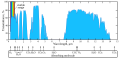 Atmosfaerisk spredning
 -
 Effect of emissivity on apparent temperature
 -
 Active Infrared Night Vision
 -
 STS-3 infrared on reentry
 -
Specim aisaowl outdoor
-
 Blue infrared light
 -
 Infrared portrait comparison
 -
 Hooded dryer for infrared hair drying at hair salon - shown from three perspectives
 -
 NOAA Shares First Infrared Imagery from GOES-17
 -
 Greenhouse effect


.gif)


