Inflation: Difference between revisions
CSV import |
CSV import |
||
| Line 37: | Line 37: | ||
{{stub}} | {{stub}} | ||
{{dictionary-stub1}} | {{dictionary-stub1}} | ||
== Inflation == | |||
<gallery> | |||
File:World_inflation_rate_April_2024.png|World inflation rate April 2024 | |||
File:UK_and_US_1989-present_monthly_CPI.svg|UK and US 1989-present monthly CPI | |||
File:US_Historical_Inflation_Ancient.svg|US Historical Inflation Ancient | |||
File:Decline_of_the_antoninianus.jpg|Decline of the antoninianus | |||
File:Inflation_data.webp|Inflation data | |||
File:CPI_1914-2022.webp|CPI 1914-2022 | |||
File:M2_and_Inflation_USA.svg|M2 and Inflation USA | |||
File:Restaurant_increasing_prices_by_$1.00_due_to_inflation.jpg|Restaurant increasing prices by $1.00 due to inflation | |||
File:Subway_pizza_inflation_2022_jeh.jpg|Subway pizza inflation 2022 | |||
File:Federal_Funds_Rate_(effective).svg|Federal Funds Rate (effective) | |||
File:Two_20kr_gold_coins.png|Two 20kr gold coins | |||
</gallery> | |||
Latest revision as of 21:34, 23 February 2025
Inflation is a term used in economics to describe a general increase in prices and fall in the purchasing value of money. It is a key economic indicator that is closely monitored by governments, businesses, and consumers alike.
Causes of Inflation[edit]
Inflation can be caused by a variety of factors, including an increase in production costs, higher demand for goods and services, and changes in government policy.
Increase in Production Costs[edit]
When the cost of producing goods or services increases, businesses often pass these costs onto consumers in the form of higher prices. This can lead to inflation. For example, if the price of oil rises, it can increase the cost of transportation, which can then lead to higher prices for goods and services.
Higher Demand for Goods and Services[edit]
Inflation can also occur when demand for goods and services outstrips supply. This can happen during periods of economic growth when consumers have more disposable income to spend.
Changes in Government Policy[edit]
Government policies can also contribute to inflation. For example, if a government decides to print more money, it can lead to an oversupply of money in the economy, which can then lead to inflation.
Effects of Inflation[edit]
Inflation can have both positive and negative effects on an economy.
Positive Effects[edit]
Inflation can stimulate economic growth by encouraging spending and investment. It can also help to reduce the real burden of debt.
Negative Effects[edit]
However, high levels of inflation can erode purchasing power and create uncertainty in the economy. It can also lead to a redistribution of wealth from savers to borrowers.
Measuring Inflation[edit]
Inflation is typically measured using a price index, which tracks the prices of a basket of goods and services over time. The most commonly used price index is the Consumer Price Index (CPI).
Controlling Inflation[edit]
Central banks often have the responsibility of controlling inflation. They can do this by adjusting interest rates, controlling the money supply, or through other monetary policy tools.
See Also[edit]
 | |
|---|---|
 |
 |
Inflation[edit]
-
 World inflation rate April 2024
 -
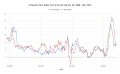 UK and US 1989-present monthly CPI
 -
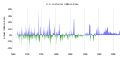 US Historical Inflation Ancient
 -
 Decline of the antoninianus
 -
 Inflation data
 -
 CPI 1914-2022
 -
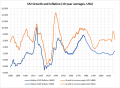 M2 and Inflation USA
 -
 Restaurant increasing prices by $1.00 due to inflation
 -
 Subway pizza inflation 2022
 -
Federal Funds Rate (effective)
-
Two 20kr gold coins


.svg)
