Veuve Clicquot: Difference between revisions
CSV import Tags: mobile edit mobile web edit |
CSV import |
||
| Line 32: | Line 32: | ||
* [http://www.veuve-clicquot.com Official Website] | * [http://www.veuve-clicquot.com Official Website] | ||
{{dictionary-stub1}} | {{dictionary-stub1}} | ||
<gallery> | |||
File:Logo_Veuve_Clicquot.png|Veuve Clicquot | |||
File:Veuve-Clicquot-Boursault.jpg|Veuve Clicquot | |||
File:Grands_Millesimes_Veuve_Cicquot.jpg|Veuve Clicquot | |||
File:Veuve_clicquot_bottle_sizes.jpg|Veuve Clicquot | |||
File:Riddling_racks,_Veuve_Clicquot_cellars.jpg|Veuve Clicquot | |||
File:Veuve_Clicquot_Ponsardin.JPG|Veuve Clicquot | |||
File:HK_TST_尖沙咀_Tsim_Sha_Tsui_河內道_18_Hanoi_Road_購物藝術館_K11_mall_shop_wines_September_2020_SS2_02.jpg|Veuve Clicquot | |||
File:“Veuve.Clicquot_Ponsardin”_champagne_1896_ad_-_17th_annual_regatta,_Larchmont_yacht_club,_July_4,_1896_(IA_17thannualregatt00larc)_(page_22_crop).jpg|Veuve Clicquot | |||
File:2018_Yelloween_at_Sigh_-_Sarah_Stierch_3.jpg|Veuve Clicquot | |||
</gallery> | |||
Latest revision as of 11:56, 18 February 2025
Veuve Clicquot[edit]
Veuve Clicquot Ponsardin is a prestigious Champagne house based in Reims, France. It was founded in 1772 by Philippe Clicquot, and is one of the oldest champagne houses in the world. The house is known for its consistency in quality and its signature style of rich and full-bodied champagnes.
History[edit]
The house was established by Philippe Clicquot, with the later involvement of his son, François Clicquot. François married Barbe-Nicole Ponsardin in 1798 and died in 1805, leaving his widow (veuve in French) in control of a company variously involved in banking, wool trading, and Champagne production. She became the first woman to take over a Champagne house. Under Madame Clicquot's guidance, the firm focused entirely on the last, to great success.
Production[edit]
Veuve Clicquot produces both vintage and non-vintage cuvee, as well as a prestige cuvee known as La Grande Dame. The house is known for its consistency in quality, year after year, and for its signature style of rich and full-bodied champagnes. The house uses a high proportion of Pinot Noir grapes in its blends, which gives the champagne its structure and body.
Innovations[edit]
Veuve Clicquot is credited with a great breakthrough in champagne handling that made mass production of the wine possible. Clicquot's advance involved systematically collecting the spent yeast and sediments left from fermentation in the bottle's neck by using a specialized rack. Composed much like a wooden desk with circular holes, the rack allowed a bottle of wine to be stuck sur point or upside down. Over time these sediments would settle to the bottle's neck for easy removal. This technique is still used today by houses producing Champagne.
Recognition[edit]
Veuve Clicquot's champagnes have been recognized with numerous awards and accolades over the years. The house's prestige cuvee, La Grande Dame, is consistently rated among the top champagnes in the world.
See Also[edit]
References[edit]
External Links[edit]

-
 Veuve Clicquot
 -
 Veuve Clicquot
 -
 Veuve Clicquot
 -
 Veuve Clicquot
 -
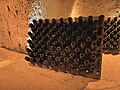 Veuve Clicquot
 -
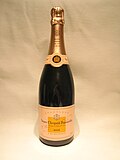 Veuve Clicquot
 -
 Veuve Clicquot
 -
 Veuve Clicquot
 -
 Veuve Clicquot


_(page_22_crop).jpg)

