Helix pomatia: Difference between revisions
CSV import Tags: mobile edit mobile web edit |
CSV import |
||
| Line 29: | Line 29: | ||
{{stub}} | {{stub}} | ||
== Helix_pomatia == | |||
<gallery> | |||
File:Helix_pomatia_89a.jpg|Helix pomatia 89a | |||
File:Helix-pomatia_Presence_in_European_countries.png|Helix pomatia Presence in European countries | |||
File:SnailMeeting.jpg|Snail Meeting | |||
File:Helix_pomatia_eye_microscopical.jpg|Helix pomatia eye microscopical | |||
File:Helix_pomatia_MHNT.ZOO.2002.0.33.jpg|Helix pomatia MHNT.ZOO.2002.0.33 | |||
File:Vinbergssnäcka_lägger_ägg.jpg|Vinbergssnäcka lägger ägg | |||
File:Helix_pomatia_reproductive_system.jpg|Helix pomatia reproductive system | |||
File:Weinbergschnecke_Paarung.jpg|Weinbergschnecke Paarung | |||
File:Helix_pomatia_head_mating.jpg|Helix pomatia head mating | |||
File:Helix_pomatia_laying_eggs_2.png|Helix pomatia laying eggs 2 | |||
File:Helix_pomatia_hibernation.png|Helix pomatia hibernation | |||
File:Helix_pomatia_operculum_hg.jpg|Helix pomatia operculum hg | |||
</gallery> | |||
Latest revision as of 21:19, 23 February 2025
Helix pomatia, also known as the Roman snail, Burgundy snail, edible snail or escargot, is a species of large, edible, air-breathing land snail, a terrestrial pulmonate gastropod mollusk in the family Helicidae. It is a European species.
Description[edit]
The Helix pomatia is one of the largest species of snails in the world. It has a soft, slimy body which is protected by a hard, round shell. The shell is usually pale brown in color and may be covered in soil or vegetation. The snail has a pair of tentacles on its head, which are used for sensing its environment and for finding food.
Distribution and habitat[edit]
The Helix pomatia is native to Europe, but it has been introduced to many other parts of the world, including North America and Australia. It prefers to live in damp, shady places, such as under rocks or in the undergrowth of forests. It is also commonly found in gardens and agricultural areas, where it can be a pest.
Diet[edit]
The Helix pomatia is a herbivore and feeds on a variety of plant material, including leaves, stems, and fruits. It has a particular preference for decaying organic matter.
Reproduction[edit]
The Helix pomatia is a hermaphrodite, meaning that each individual has both male and female reproductive organs. During mating, two snails exchange sperm, and each then lays a batch of eggs in a hole in the soil. The eggs hatch after a few weeks, producing tiny, fully-formed snails.
Human use[edit]
The Helix pomatia is commonly collected and eaten by humans, particularly in France, where it is known as 'escargot'. It is also used in the cosmetics industry, as its slime is believed to have beneficial properties for the skin.
Conservation status[edit]
The Helix pomatia is not currently considered to be at risk of extinction. However, its populations are declining in some areas due to habitat loss and over-collection for the food trade.
See also[edit]
 | |
|---|---|
 |
 |
Helix_pomatia[edit]
-
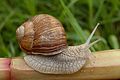 Helix pomatia 89a
 -
 Helix pomatia Presence in European countries
 -
 Snail Meeting
 -
 Helix pomatia eye microscopical
 -
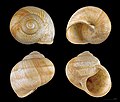 Helix pomatia MHNT.ZOO.2002.0.33
 -
 Vinbergssnäcka lägger ägg
 -
 Helix pomatia reproductive system
 -
 Weinbergschnecke Paarung
 -
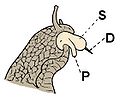 Helix pomatia head mating
 -
 Helix pomatia laying eggs 2
 -
 Helix pomatia hibernation
 -
 Helix pomatia operculum hg


