Hand washing: Difference between revisions
CSV import Tags: mobile edit mobile web edit |
CSV import |
||
| Line 26: | Line 26: | ||
{{stub}} | {{stub}} | ||
<gallery> | |||
File:OCD handwash.jpg|Hand washing | |||
File:Poster "Stop microbes wash your hands".jpg|Stop microbes wash your hands | |||
File:Supervising a young boy washing his hands.jpg|Supervising a young boy washing his hands | |||
File:HandCleaning.JPG|Hand cleaning | |||
File:04 Hegasy Hand Disinfection Wiki EN CCBYSA.png|Hand disinfection | |||
File:Pupil washes hands during COVID-19 pandemic in Ghana.jpg|Pupil washes hands during COVID-19 pandemic in Ghana | |||
File:A nurse uses a smart hand washing device.jpg|A nurse uses a smart hand washing device | |||
File:In Rwanda build where everyone can wash hand in prevention of covid-19.jpg|In Rwanda build where everyone can wash hand in prevention of COVID-19 | |||
File:Hand Washing.webmhd.webm|Hand washing | |||
File:Hand desinfection test with blood agar plate.jpg|Hand desinfection test with blood agar plate | |||
File:Proportion of population with basic handwashing facilities on premises, OWID.svg|Proportion of population with basic handwashing facilities on premises | |||
File:Hand washing comic.jpg|Hand washing comic | |||
</gallery> | |||
Latest revision as of 01:11, 20 February 2025
Hand washing is a crucial practice in maintaining personal hygiene and preventing the spread of diseases. It involves the use of water and soap to clean the hands, and is considered one of the most effective ways to prevent the spread of pathogens and infections.
Overview[edit]
Hand washing is a simple yet vital behavior in hospitals and other healthcare settings. It can prevent the spread of many diseases, including the common cold, flu, and other viral and bacterial infections. The World Health Organization (WHO) and the Centers for Disease Control and Prevention (CDC) recommend washing hands with soap and water as the best way to get rid of germs in most situations.
Importance[edit]
Hand washing is important because it's the first line of defense against the spread of many diseases. From the common cold to more serious infections such as meningitis, bronchitis, influenza, hepatitis A, and many types of diarrhea, hand washing can prevent the spread of a variety of pathogens.
Technique[edit]
The correct hand washing technique is important to ensure all parts of the hands are cleaned. This includes the palms, back of the hands, wrists, between the fingers and under the fingernails. The process should take at least 20 seconds, and involves five steps: wet, lather, scrub, rinse and dry.
Hand Sanitizers[edit]
When soap and water are not available, hand sanitizers can be used as an alternative. They are not as effective as hand washing in removing all types of germs, but they can quickly reduce the number of germs on hands in many situations.
See Also[edit]
References[edit]
<references />
 | |
|---|---|
 |
 |
-
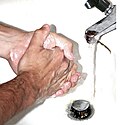 Hand washing
 -
 Stop microbes wash your hands
 -
 Supervising a young boy washing his hands
 -
 Hand cleaning
 -
 Hand disinfection
 -
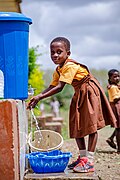 Pupil washes hands during COVID-19 pandemic in Ghana
 -
 A nurse uses a smart hand washing device
 -
 In Rwanda build where everyone can wash hand in prevention of COVID-19
 -
 Hand washing
 -
 Hand desinfection test with blood agar plate
 -
 Proportion of population with basic handwashing facilities on premises
 -
 Hand washing comic


