Runeberg torte: Difference between revisions
CSV import Tags: mobile edit mobile web edit |
CSV import |
||
| Line 25: | Line 25: | ||
The [[Runeberg torte]] is a beloved Finnish pastry with a rich history and cultural significance. Its unique combination of flavors and textures make it a favorite among both locals and tourists. Whether enjoyed on [[Runeberg's Day]] or as a special treat during the holiday season, the Runeberg torte is a delicious symbol of Finnish culinary tradition. | The [[Runeberg torte]] is a beloved Finnish pastry with a rich history and cultural significance. Its unique combination of flavors and textures make it a favorite among both locals and tourists. Whether enjoyed on [[Runeberg's Day]] or as a special treat during the holiday season, the Runeberg torte is a delicious symbol of Finnish culinary tradition. | ||
{{dictionary-stub1}} | {{dictionary-stub1}} | ||
==Runeberg_torte== | |||
<gallery> | |||
File:Runebergintorttu.jpg|Runebergintorttu | |||
File:Runebergsbakelse_i_Fredrika_Runeberg_receptbok,_1850-talet.jpg|Runebergsbakelse in Fredrika Runeberg's recipe book, 1850s | |||
</gallery> | |||
Latest revision as of 21:37, 20 February 2025
Introduction[edit]
Runeberg torte is a Finnish pastry named after the national poet of Finland, Johan Ludvig Runeberg. It is traditionally eaten on Runeberg's Day, which is celebrated on the 5th of February each year. The torte is a small, cylindrical pastry soaked in rum or arrack and topped with raspberry jam inside a sugar ring.
History[edit]
The Runeberg torte was created by Fredrika Runeberg, the wife of Johan Ludvig Runeberg. She was known for her culinary skills and created the torte using leftover ingredients in her kitchen. The torte quickly became a favorite in the Runeberg household and was later popularized throughout Finland.
Ingredients and Preparation[edit]
The main ingredients of a Runeberg torte include almonds, breadcrumbs, butter, sugar, and eggs. The torte is flavored with rum or arrack and topped with raspberry jam and icing sugar.
To prepare the torte, the almonds and breadcrumbs are first ground into a fine mixture. This mixture is then combined with the butter, sugar, and eggs to form a dough. The dough is shaped into small cylinders and baked until golden brown. Once cooled, the tortes are soaked in a rum or arrack syrup and topped with raspberry jam and a ring of icing sugar.
Cultural Significance[edit]
The Runeberg torte holds a significant place in Finnish culture. It is traditionally eaten on Runeberg's Day, which is celebrated on the 5th of February each year. This day marks the birth of Johan Ludvig Runeberg, the national poet of Finland. The torte is also a popular treat during the Christmas season.
Variations[edit]
There are several variations of the Runeberg torte. Some recipes use different types of alcohol for the syrup, such as brandy or cognac. Others replace the raspberry jam with other types of fruit jam, such as strawberry or blackcurrant. There are also gluten-free and vegan versions of the torte available.
Conclusion[edit]
The Runeberg torte is a beloved Finnish pastry with a rich history and cultural significance. Its unique combination of flavors and textures make it a favorite among both locals and tourists. Whether enjoyed on Runeberg's Day or as a special treat during the holiday season, the Runeberg torte is a delicious symbol of Finnish culinary tradition.

Runeberg_torte[edit]
-
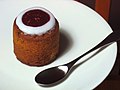 Runebergintorttu
 -
 Runebergsbakelse in Fredrika Runeberg's recipe book, 1850s


