Dipteryx odorata: Difference between revisions
CSV import |
CSV import |
||
| Line 29: | Line 29: | ||
{{stub}} | {{stub}} | ||
{{dictionary-stub1}} | {{dictionary-stub1}} | ||
<gallery> | |||
File:Flowering_Tonka_Bean_tree_(Dipteryx_odorata).jpg|Flowering Tonka Bean tree | |||
File:Cumaru_(Dipteryx_odorata),_Vaca_Diez,_Bolivia_1.jpg|Cumaru tree in Vaca Diez, Bolivia | |||
File:The_smooth_brown_inside_of_the_tonka_bean.jpg|The smooth brown inside of the tonka bean | |||
</gallery> | |||
Latest revision as of 04:17, 18 February 2025
Dipteryx odorata is a species of flowering tree in the pea family, Fabaceae. The tree is native to Central America and northern South America. Its seeds are known as tonka beans (sometimes tonkin beans or tonquin beans). They are black and wrinkled and have a smooth, brown interior. They have a strong fragrance similar to sweet woodruff (Galium odoratum) due to their high coumarin content.
Description[edit]
The Dipteryx odorata tree grows up to 25–30 meters, with a trunk of up to one meter in diameter. The tree bark is smooth and gray, whereas the wood is red. The tree has alternate pinnate leaves with three to six leaflets, leathery, glossy and dark green, and pink flowers.
Uses[edit]
The tonka bean is used as a source of coumarin, a fragrant compound that is used in the manufacture of perfumes. The beans are also used as a spice in some dishes and desserts, particularly in French cuisine. The use of tonka beans in food is banned in some countries due to its coumarin content.
Cultivation[edit]
Dipteryx odorata is a forest tree that prefers humid and hot climates. It is a slow-growing tree, which makes it less popular in reforestation programs.
See also[edit]
References[edit]
<references />
External links[edit]
- Dipteryx odorata at WikiMD
 | |
|---|---|
 |
 |
| This medical article is a stub. You can help Wikipedia by adding missing information. |
-
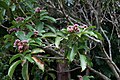 Flowering Tonka Bean tree
 -
 Cumaru tree in Vaca Diez, Bolivia
 -
 The smooth brown inside of the tonka bean
.jpg)
,_Vaca_Diez,_Bolivia_1.jpg)

