In-water recompression: Difference between revisions
CSV import Tags: mobile edit mobile web edit |
CSV import |
||
| Line 30: | Line 30: | ||
[[Category:Medical treatments]] | [[Category:Medical treatments]] | ||
[[Category:Underwater diving procedures]] | [[Category:Underwater diving procedures]] | ||
<gallery> | |||
File:Australian_IWR.jpg|In-water recompression in Australia | |||
File:Clipperton_IWR.jpg|In-water recompression at Clipperton | |||
File:Clipperton_a_IWR.jpg|In-water recompression at Clipperton (a) | |||
File:Hawaiian_IWR.jpg|In-water recompression in Hawaii | |||
File:Pyle_IWR.jpg|In-water recompression by Pyle | |||
File:USN_Type1Sx_IWR.jpg|US Navy Type 1 Sx in-water recompression | |||
File:USN_Type2Sx_IWR.jpg|US Navy Type 2 Sx in-water recompression | |||
File:CC-BY_icon.svg|In-water recompression | |||
</gallery> | |||
Latest revision as of 11:16, 18 February 2025
In-water_recompression (IWR) is a procedure used in the field of diving medicine to treat decompression sickness (DCS), also known as "the bends". This technique involves a diver who has surfaced too quickly returning to a depth where the pressure will reduce the size of the bubbles causing the symptoms, and then ascending slowly and making additional decompression stops to allow the bubbles to dissolve safely.
History[edit]
The concept of in-water recompression has been around since the early days of diving, but it was not until the 1990s that it began to be used in a more formal and controlled manner. The procedure was initially used as a last resort when surface recompression in a hyperbaric chamber was not available.
Procedure[edit]
The procedure for in-water recompression involves the diver returning to a depth where the symptoms of decompression sickness are reduced. This is typically between 9 and 18 metres (30 and 60 feet). The diver then ascends slowly, making additional decompression stops as necessary. The exact depth and duration of the stops will depend on the severity of the symptoms and the dive profile that led to the decompression sickness.
Risks and Controversies[edit]
While in-water recompression can be an effective treatment for decompression sickness, it is not without risks. The procedure requires the diver to return to depth, which can increase the risk of oxygen toxicity and pulmonary barotrauma. There is also the risk that the diver may become unconscious or incapacitated while underwater, which could lead to drowning.
Despite these risks, in-water recompression is sometimes the only available treatment option in remote locations where a hyperbaric chamber is not available. However, the use of in-water recompression remains controversial, and it is not universally accepted as a standard treatment for decompression sickness.
See Also[edit]
References[edit]
<references />
 | |
|---|---|
 |
 |
-
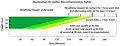 In-water recompression in Australia
 -
In-water recompression at Clipperton
-
In-water recompression at Clipperton (a)
-
 In-water recompression in Hawaii
 -
In-water recompression by Pyle
-
 US Navy Type 1 Sx in-water recompression
 -
US Navy Type 2 Sx in-water recompression
-
In-water recompression


