Schinus terebinthifolia: Difference between revisions
CSV import Tags: mobile edit mobile web edit |
CSV import Tags: mobile edit mobile web edit |
||
| Line 36: | Line 36: | ||
* [[Schinus terebinthifolia on USDA Plants Database]] | * [[Schinus terebinthifolia on USDA Plants Database]] | ||
{{dictionary-stub1}} | {{dictionary-stub1}} | ||
== Schinus_terebinthifolia == | |||
<gallery> | |||
File:Starr_041018-0009_Schinus_terebinthifolius.jpg|Starr 041018-0009 Schinus terebinthifolius | |||
File:Schinus_terebinthifolius_leaves.jpg|Schinus terebinthifolius leaves | |||
File:Schinus_terebinthifolius_flowers.jpg|Schinus terebinthifolius flowers | |||
File:Schinus_terebinthifolius_stem.jpg|Schinus terebinthifolius stem | |||
File:Pink_Peppercorns_(Schinus_terebinthifolius).JPG|Pink Peppercorns (Schinus terebinthifolius) | |||
File:Brazilian_pepper_tree.jpg|Brazilian pepper tree | |||
</gallery> | |||
Latest revision as of 00:51, 27 February 2025
Schinus terebinthifolia[edit]
Schinus terebinthifolia, commonly known as the Brazilian pepper tree, is a flowering plant species in the cashew family, Anacardiaceae. It is native to subtropical and tropical South America (southeastern Brazil, northern Argentina, and Paraguay). It is present in other subtropical regions of the world as an invasive species.
Description[edit]
Schinus terebinthifolia is an evergreen tree that can reach heights of 7–10 meters. The leaves are alternate, 10–22 cm long, pinnate (rarely bipinnate), with 5-13 leaflets; the leaflets are roughly oval (lanceolate to elliptic), 3–6 cm long and 2–3.5 cm broad, and have finely toothed margins, a leathery texture and a glossy surface.
Distribution and habitat[edit]
The Brazilian pepper tree is native to the subtropical and tropical regions of South America. However, it has become an invasive species in several other subtropical regions, including parts of the United States, Australia, and South Africa. It thrives in a variety of habitats, from marshes and mangrove forests to pine flatwoods and scrub habitats.
Uses[edit]
The tree's bright red fruit and lush foliage make it a popular ornamental plant in its native range. The fruit is also used as a spice, similar to black pepper, in Brazilian cuisine. However, the tree's invasive nature has led to it being classified as a weed in many regions outside its native range.
Invasive species[edit]
In regions where it has been introduced, such as Florida, California, Texas, and Hawaii in the United States, Schinus terebinthifolia has become a major ecological problem. It forms dense thickets that displace native vegetation, alter habitats, and negatively impact wildlife.
Control and management[edit]
Efforts to control the spread of the Brazilian pepper tree include mechanical methods, such as cutting and burning, and chemical methods, such as herbicide application. Biological control agents, such as insects and pathogens that attack the tree, have also been investigated and used with varying degrees of success.
See also[edit]
References[edit]
External links[edit]
- Schinus terebinthifolia on Invasive Species Compendium
- Schinus terebinthifolia on USDA Plants Database

Schinus_terebinthifolia[edit]
-
 Starr 041018-0009 Schinus terebinthifolius
 -
 Schinus terebinthifolius leaves
 -
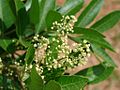 Schinus terebinthifolius flowers
 -
 Schinus terebinthifolius stem
 -
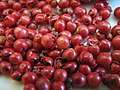 Pink Peppercorns (Schinus terebinthifolius)
 -
 Brazilian pepper tree


.JPG)

