Thinopyrum intermedium: Difference between revisions
CSV import Tags: mobile edit mobile web edit |
CSV import Tags: mobile edit mobile web edit |
||
| Line 23: | Line 23: | ||
{{stub}} | {{stub}} | ||
== Thinopyrum intermedium == | |||
<gallery> | |||
File:Thinopyrum_intermedium_field.jpg|Thinopyrum intermedium field | |||
File:4_Seasons_Roots.jpg|4 Seasons Roots | |||
File:Thinopyrum_intermedium_head_types.JPG|Thinopyrum intermedium head types | |||
File:New_IWG_seeding.JPG|New IWG seeding | |||
File:Breeding_nursery_of_Thinopyrum_intermedium.JPG|Breeding nursery of Thinopyrum intermedium | |||
File:Thinopyrum_intermedium_first_year_nursery.JPG|Thinopyrum intermedium first year nursery | |||
File:Dwarf_and_Wild_Thinopyrum_intermedium.JPG|Dwarf and Wild Thinopyrum intermedium | |||
</gallery> | |||
Latest revision as of 12:03, 25 February 2025
Thinopyrum intermedium, also known as intermediate wheatgrass, is a species of wheatgrass native to Europe and Western Asia. It is a perennial grass that is often used for forage and soil conservation purposes.
Etymology[edit]
The genus name Thinopyrum is derived from the Greek words thinos (meaning "sand") and pyros (meaning "wheat"), referring to the plant's natural habitat. The species name intermedium refers to its intermediate size compared to other species in the genus.
Description[edit]
Thinopyrum intermedium is a robust, perennial grass that can grow up to 1.5 meters tall. It has a deep root system, which makes it drought-resistant and suitable for soil conservation. The leaves are flat and rough, and the inflorescence is a dense, spike-like panicle.
Distribution and habitat[edit]
Thinopyrum intermedium is native to Europe and Western Asia, but it has been introduced to other parts of the world, including North America. It is typically found in sandy or rocky soils, and it can tolerate a wide range of environmental conditions.
Uses[edit]
Thinopyrum intermedium is often used for forage, as it provides a high-quality feed for livestock. It is also used for soil conservation, as its deep root system helps to prevent soil erosion. In addition, it has been used in the development of new wheat varieties, as it has resistance to several wheat diseases.
See also[edit]
 | |
|---|---|
 |
 |
Thinopyrum intermedium[edit]
-
 Thinopyrum intermedium field
 -
 4 Seasons Roots
 -
 Thinopyrum intermedium head types
 -
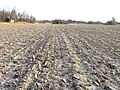 New IWG seeding
 -
Breeding nursery of Thinopyrum intermedium
-
Thinopyrum intermedium first year nursery
-
Dwarf and Wild Thinopyrum intermedium


