External obturator muscle: Difference between revisions
CSV import |
CSV import |
||
| Line 35: | Line 35: | ||
{{stub}} | {{stub}} | ||
==External obturator muscle== | |||
<gallery> | |||
File:Obturator_externus.png|Obturator externus muscle | |||
File:Gray235.png|Muscles of the right hip, viewed from the front | |||
File:Gray344.png|The Obturator externus muscle and surrounding structures | |||
File:Gray433.png|The Obturator externus muscle in relation to the hip joint | |||
File:Slide2gen.JPG|External obturator muscle | |||
File:Slide8A.JPG|External obturator muscle | |||
File:Slide1BIBI.JPG|External obturator muscle | |||
</gallery> | |||
Latest revision as of 11:13, 18 February 2025
External obturator muscle
The External obturator muscle or obturator externus is a thin, flat muscle of the human body located in the pelvis. It is part of the medial compartment of thigh and plays a crucial role in the movement of the hip joint.
Etymology[edit]
The term "obturator" comes from the Latin "obturare", which means to close or obstruct. This is in reference to the muscle's function in closing off the obturator foramen, a large opening in the hip bone.
Anatomy[edit]
The external obturator muscle originates from the margins of the obturator foramen and converges to a tendon, which inserts into the trochanter of the femur. It is innervated by the obturator nerve and is supplied by the obturator artery.
Function[edit]
The primary function of the external obturator muscle is to laterally rotate the thigh at the hip joint. It also helps to stabilize the hip joint by pulling the head of the femur into the acetabulum, the socket of the hip bone.
Clinical significance[edit]
Injury or strain to the external obturator muscle can result in hip pain and limited mobility. It may also be involved in conditions such as hip dysplasia and osteoarthritis.
Related terms[edit]
- Obturator internus muscle
- Obturator nerve
- Obturator artery
- Obturator foramen
- Hip joint
- Femur
- Trochanter
- Acetabulum
See also[edit]
 | |
|---|---|
 |
 |
External obturator muscle[edit]
-
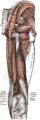 Obturator externus muscle
 -
 Muscles of the right hip, viewed from the front
 -
 The Obturator externus muscle and surrounding structures
 -
 The Obturator externus muscle in relation to the hip joint
 -
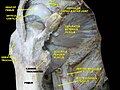 External obturator muscle
 -
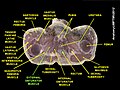 External obturator muscle
 -
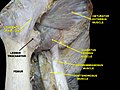 External obturator muscle


