Mortality rate: Difference between revisions
No edit summary |
CSV import |
||
| Line 30: | Line 30: | ||
[[Category:Medical terminology]] | [[Category:Medical terminology]] | ||
[[Category:Demography]]{{stub}} | [[Category:Demography]]{{stub}} | ||
<gallery> | |||
File:Mortality Rate Map by Country.svg|Mortality rate | |||
File:Income death in logs graph.JPG|Mortality rate | |||
</gallery> | |||
Latest revision as of 01:18, 20 February 2025
The mortality rate, also known as the death rate, is a fundamental metric in epidemiology and public health that quantifies the frequency of death within a defined population over a specific timeframe. This statistic provides valuable insights into a population's health status, enabling healthcare providers and policymakers to respond effectively to emerging health challenges.
Calculation and Interpretation[edit]
The mortality rate is usually calculated per 1,000 or 100,000 individuals, often annually. It is computed by dividing the number of deaths occurring in a specific period by the population at risk during that period. This number is then multiplied by 1,000 or 100,000 to provide a standardized rate that can be used for comparison across different populations and timeframes.
It's important to note that the mortality rate is an aggregate figure and does not account for age-specific or cause-specific variations in mortality. For these considerations, researchers use measures such as age-specific mortality rate and cause-specific mortality rate.
Types of Mortality Rates[edit]
Several types of mortality rates provide specific information about a population:
- Crude mortality rate: The total number of deaths in a population, regardless of cause or age, divided by the total population.
- Infant mortality rate: The number of deaths of infants under one year old per 1,000 live births in a given year.
- Age-specific mortality rate: The mortality rate within specific age groups of a population.
- Cause-specific mortality rate: The mortality rate for a specific cause of death in a population.
Utilization in Public Health[edit]
Mortality rates are essential tools in public health for assessing overall health status, monitoring trends, and informing health policy. They help identify high-risk populations, evaluate the effectiveness of health interventions, and direct resource allocation. They also play a significant role in epidemiological research and health-related socio-economic studies.
References[edit]
<references group="" responsive="1"></references>
See Also[edit]
 | |
|---|---|
 |
 |
-
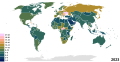 Mortality rate
 -
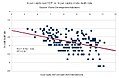 Mortality rate


