Perfume: Difference between revisions
CSV import Tags: mobile edit mobile web edit |
No edit summary |
||
| (One intermediate revision by the same user not shown) | |||
| Line 1: | Line 1: | ||
'''Perfume''' is a mixture of fragrant essential oils or aroma compounds, fixatives, and solvents, used to give the human body, animals, food, objects, and living spaces an agreeable scent. It is usually in liquid form and used to give a pleasant scent to a person's body. Ancient texts and archaeological excavations show the use of perfumes in some of the earliest human civilizations. | |||
==History== | |||
The word perfume derives from the Latin ''perfumare'', meaning "to smoke through". Perfumery, as the art of making perfumes, began in ancient Mesopotamia, Egypt, the Indus Valley Civilization and possibly Ancient China. It was further refined by the Romans and the Arabs. | |||
== | ==Types of Perfume== | ||
Perfume types reflect the concentration of aromatic compounds in a solvent, which in fine fragrance is typically ethanol or a mix of water and ethanol. Various sources differ considerably in the definitions of perfume types. The intensity and longevity of a perfume is based on the concentration, intensity, and longevity of the aromatic compounds, or perfume oils, used. | |||
== | ==Making Perfume== | ||
The most practical way to start describing a perfume is according to the elements of the fragrance notes of the scent or the "family" it belongs to, all of which affect the overall impression of a perfume from first application to the last lingering hint of scent. | |||
==Health and Environmental Issues== | |||
Some research on natural aromatics have shown that many contain compounds that cause skin irritation. However, some studies have found that these compounds are not harmful and have health benefits. | |||
== | == Gallery == | ||
<gallery> | |||
File:Lily_perfume_Louvre_E11162.jpg|Perfume | |||
File:Arheologicheski-Perfume.jpg|Perfume | |||
File:Perfume_vessel_in_shape_of_a_monkey_MET_DP228710.jpg|Perfume | |||
File:1811-Rosoli-Flacon.jpg|Perfume | |||
File:Vintage_Atomizer_Perfume_Bottle.JPG|Perfume | |||
File:J.B._Filz_Vienna_2007.jpg|Perfume | |||
File:Fougère_Royale_by_Paul_Parquet_-_Bottle.jpg|Perfume | |||
File:Fragrance_pyramid.svg|Perfume | |||
File:Joy_Jean_Patou.jpg|Perfume | |||
File:Wheel2.gif|Perfume | |||
File:Citrus_x_limon_Blüten_und_Schädlinge.JPG|Perfume | |||
File:Myrrh.JPG|Perfume | |||
</gallery> | |||
==See Also== | |||
* [[Eau de Cologne]] | |||
* [[Eau de Toilette]] | |||
* [[Eau de Parfum]] | |||
== | |||
* | |||
* | |||
* | |||
* [[Essential oil]] | * [[Essential oil]] | ||
* [[Aromatherapy]] | * [[Aromatherapy]] | ||
[[Category:Perfumes]] | [[Category:Perfumes]] | ||
[[Category:Cosmetics]] | |||
[[Category:Personal care products]] | |||
Latest revision as of 20:35, 22 February 2025
Perfume is a mixture of fragrant essential oils or aroma compounds, fixatives, and solvents, used to give the human body, animals, food, objects, and living spaces an agreeable scent. It is usually in liquid form and used to give a pleasant scent to a person's body. Ancient texts and archaeological excavations show the use of perfumes in some of the earliest human civilizations.
History[edit]
The word perfume derives from the Latin perfumare, meaning "to smoke through". Perfumery, as the art of making perfumes, began in ancient Mesopotamia, Egypt, the Indus Valley Civilization and possibly Ancient China. It was further refined by the Romans and the Arabs.
Types of Perfume[edit]
Perfume types reflect the concentration of aromatic compounds in a solvent, which in fine fragrance is typically ethanol or a mix of water and ethanol. Various sources differ considerably in the definitions of perfume types. The intensity and longevity of a perfume is based on the concentration, intensity, and longevity of the aromatic compounds, or perfume oils, used.
Making Perfume[edit]
The most practical way to start describing a perfume is according to the elements of the fragrance notes of the scent or the "family" it belongs to, all of which affect the overall impression of a perfume from first application to the last lingering hint of scent.
Health and Environmental Issues[edit]
Some research on natural aromatics have shown that many contain compounds that cause skin irritation. However, some studies have found that these compounds are not harmful and have health benefits.
Gallery[edit]
-
 Perfume
 -
 Perfume
 -
 Perfume
 -
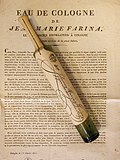 Perfume
 -
 Perfume
 -
 Perfume
 -
 Perfume
 -
 Perfume
 -
 Perfume
 -
 Perfume
 -
 Perfume
 -
 Perfume


