Deciduous: Difference between revisions
CSV import Tags: mobile edit mobile web edit |
CSV import |
||
| (One intermediate revision by the same user not shown) | |||
| Line 1: | Line 1: | ||
{{short description|Type of plant that sheds its leaves seasonally}} | |||
== | ==Deciduous== | ||
[[File:Flickr_-_Nicholas_T_-_Open_Woods.jpg|thumb|Deciduous forest in early spring]] | |||
Deciduous trees are | Deciduous trees and shrubs are those that lose all of their leaves for part of the year. This process is known as abscission. The term "deciduous" means "falling off at maturity" or "tending to fall off". It is typically used in reference to trees or shrubs that lose their leaves seasonally, most commonly in autumn. | ||
== | ==Characteristics== | ||
[[File:Flickr_-_Nicholas_T_-_Lofty.jpg|thumb|left|Deciduous trees in a forest setting]] | |||
Deciduous plants are characterized by their ability to shed leaves to conserve water or to survive cold or dry seasons. This adaptation is particularly beneficial in temperate climates, where the growing season is limited by cold temperatures. During the leafless period, deciduous plants enter a state of dormancy, reducing metabolic activity and conserving resources. | |||
The leaves of deciduous plants are typically broad and flat, which allows for efficient photosynthesis during the growing season. However, these leaves are also more susceptible to damage from cold temperatures, which is why they are shed before winter in temperate regions. | |||
==Ecological Role== | |||
[[File:Autumnal_deciduous_forest_-_Laubwand_im_Herbst.jpg|thumb|Deciduous forest in autumn]] | |||
Deciduous forests play a crucial role in the ecosystem. They provide habitat and food for a wide variety of wildlife. The leaf litter that accumulates on the forest floor decomposes and enriches the soil, supporting a diverse range of plant and animal life. | |||
In addition, deciduous forests help regulate the Earth's climate by absorbing carbon dioxide during the growing season. The seasonal shedding of leaves also contributes to the carbon cycle, as decomposing leaves release carbon back into the atmosphere. | |||
== | ==Types of Deciduous Plants== | ||
[[File:Langaa_egeskov_rimfrost.jpg|thumb|left|Frost on deciduous trees]] | |||
Deciduous plants can be found in various forms, including trees, shrubs, and herbaceous plants. Some common examples of deciduous trees include oak, maple, and birch. Deciduous shrubs include species like forsythia and lilac. | |||
In addition to temperate deciduous forests, there are also tropical and subtropical deciduous forests, where plants shed their leaves during the dry season to conserve water. | |||
==Adaptations== | |||
[[File:Forsythia_turin.JPG|thumb|Forsythia, a deciduous shrub]] | |||
Deciduous plants have developed several adaptations to survive in their environments. These include: | |||
* '''Leaf abscission''': The process of shedding leaves involves the formation of an abscission layer at the base of the leaf stem, which cuts off the supply of nutrients and water, causing the leaf to fall off. | |||
* '''Dormancy''': During the leafless period, deciduous plants enter a state of dormancy, reducing metabolic activity and conserving energy. | |||
* '''Thick bark''': Many deciduous trees have thick bark to protect against cold temperatures and pests. | |||
==Seasonal Changes== | |||
[[File:Autumn_Leaf_08Nov17.jpg|thumb|left|Autumn leaf from a deciduous tree]] | |||
The most noticeable change in deciduous plants is the color change in leaves during autumn. As daylight decreases and temperatures drop, chlorophyll breaks down, revealing other pigments such as carotenoids and anthocyanins, which give leaves their yellow, orange, and red hues. | |||
This color change is a signal that the plant is preparing for dormancy. Once the leaves have fallen, the plant conserves energy until conditions are favorable for growth in the spring. | |||
==Related Pages== | |||
* [[Evergreen]] | * [[Evergreen]] | ||
* [[ | * [[Temperate deciduous forest]] | ||
* [[ | * [[Tropical deciduous forest]] | ||
[[File:Sydney_in_Autumn.jpg|thumb|Deciduous trees in an urban setting during autumn]] | |||
==Gallery== | |||
<gallery> | <gallery> | ||
File:Chacachacare_dry_forest_3.JPG|Deciduous forest in a dry region | |||
File:Chacachacare_dry_forest_3.JPG|Deciduous | |||
</gallery> | </gallery> | ||
[[Category:Plant morphology]] | |||
[[Category:Forestry]] | |||
[[Category:Trees]] | |||
Latest revision as of 11:02, 23 March 2025
Type of plant that sheds its leaves seasonally
Deciduous[edit]

Deciduous trees and shrubs are those that lose all of their leaves for part of the year. This process is known as abscission. The term "deciduous" means "falling off at maturity" or "tending to fall off". It is typically used in reference to trees or shrubs that lose their leaves seasonally, most commonly in autumn.
Characteristics[edit]

Deciduous plants are characterized by their ability to shed leaves to conserve water or to survive cold or dry seasons. This adaptation is particularly beneficial in temperate climates, where the growing season is limited by cold temperatures. During the leafless period, deciduous plants enter a state of dormancy, reducing metabolic activity and conserving resources.
The leaves of deciduous plants are typically broad and flat, which allows for efficient photosynthesis during the growing season. However, these leaves are also more susceptible to damage from cold temperatures, which is why they are shed before winter in temperate regions.
Ecological Role[edit]

Deciduous forests play a crucial role in the ecosystem. They provide habitat and food for a wide variety of wildlife. The leaf litter that accumulates on the forest floor decomposes and enriches the soil, supporting a diverse range of plant and animal life.
In addition, deciduous forests help regulate the Earth's climate by absorbing carbon dioxide during the growing season. The seasonal shedding of leaves also contributes to the carbon cycle, as decomposing leaves release carbon back into the atmosphere.
Types of Deciduous Plants[edit]

Deciduous plants can be found in various forms, including trees, shrubs, and herbaceous plants. Some common examples of deciduous trees include oak, maple, and birch. Deciduous shrubs include species like forsythia and lilac.
In addition to temperate deciduous forests, there are also tropical and subtropical deciduous forests, where plants shed their leaves during the dry season to conserve water.
Adaptations[edit]

Deciduous plants have developed several adaptations to survive in their environments. These include:
- Leaf abscission: The process of shedding leaves involves the formation of an abscission layer at the base of the leaf stem, which cuts off the supply of nutrients and water, causing the leaf to fall off.
- Dormancy: During the leafless period, deciduous plants enter a state of dormancy, reducing metabolic activity and conserving energy.
- Thick bark: Many deciduous trees have thick bark to protect against cold temperatures and pests.
Seasonal Changes[edit]

The most noticeable change in deciduous plants is the color change in leaves during autumn. As daylight decreases and temperatures drop, chlorophyll breaks down, revealing other pigments such as carotenoids and anthocyanins, which give leaves their yellow, orange, and red hues.
This color change is a signal that the plant is preparing for dormancy. Once the leaves have fallen, the plant conserves energy until conditions are favorable for growth in the spring.
Related Pages[edit]

Gallery[edit]
-
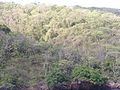 Deciduous forest in a dry region

