Brain coral: Difference between revisions
CSV import |
CSV import |
||
| Line 35: | Line 35: | ||
File:Diploria_Strigosa.jpg|Brain coral | File:Diploria_Strigosa.jpg|Brain coral | ||
File:Diploria_labyrinthiformis.jpg|Brain coral | File:Diploria_labyrinthiformis.jpg|Brain coral | ||
</gallery> | |||
<gallery> | |||
File:Brain_coral.jpg|Brain coral | |||
File:Brain_coral_spawning.jpg|Brain coral spawning | |||
File:Mozgovity_koral.jpg|Brain coral | |||
File:Koral_mozgovity_hranica.jpg|Brain coral | |||
File:Close-up_of_a_brain_coral_near_Nusa_Kode_Island,_Indonesia.JPG|Close-up of a brain coral near Nusa Kode Island, Indonesia | |||
File:Diploria_closeup_FL.jpg|Diploria closeup FL | |||
File:Diploria_SanSalvador1.jpg|Diploria San Salvador | |||
File:Fossil_Reef_Windley_Key_1.jpg|Fossil Reef Windley Key | |||
File:Diploria_Strigosa.jpg|Diploria strigosa | |||
File:Diploria_labyrinthiformis.jpg|Diploria labyrinthiformis | |||
</gallery> | </gallery> | ||
Latest revision as of 12:16, 18 February 2025
Brain Coral is a common name given to various species of coral that exhibit a brain-like appearance. These corals are part of the Phylum Cnidaria, a group of marine animals that also includes sea anemones and jellyfish. Brain corals are found in tropical oceans around the world and are a significant component of coral reefs.
Characteristics[edit]
Brain corals are named for their unique appearance, which resembles the grooves and ridges of a human brain. This pattern is created by the coral's polyps, tiny animals that make up the coral colony. Each polyp secretes a hard, calcium carbonate exoskeleton, which forms the structure of the coral. Over time, the polyps continue to grow and divide, creating the complex, maze-like structure characteristic of brain coral.
Habitat and Distribution[edit]
Brain corals are found in tropical and subtropical oceans worldwide. They are particularly prevalent in the Caribbean Sea and the Great Barrier Reef off the coast of Australia. Brain corals prefer shallow, warm waters and are typically found at depths of less than 60 meters.
Ecology[edit]
Like all corals, brain corals play a crucial role in the ecosystem of coral reefs. They provide habitat and shelter for a wide variety of marine species. Brain corals, like other hard corals, have a symbiotic relationship with zooxanthellae, a type of algae. The coral provides the algae with a protected environment and compounds necessary for photosynthesis. In return, the algae produce oxygen and help the coral to remove wastes.
Threats and Conservation[edit]
Brain corals, like many coral species, are threatened by a variety of factors. These include climate change, ocean acidification, pollution, and destructive fishing practices. Efforts are being made to conserve and protect brain corals, including the establishment of marine protected areas and the development of coral farming and transplantation techniques.

-
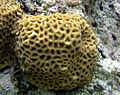 Brain coral
 -
 Brain coral
 -
 Brain coral
 -
 Brain coral
 -
 Brain coral
 -
 Brain coral
 -
 Brain coral
 -
 Brain coral
 -
 Brain coral
 -
 Brain coral
 -
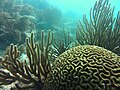 Brain coral
 -
 Brain coral

_(San_Salvador_Island,_Bahamas)_2_(15472166633).jpg)


-
Brain coral
-
Brain coral spawning
-
Brain coral
-
Brain coral
-
Close-up of a brain coral near Nusa Kode Island, Indonesia
-
Diploria closeup FL
-
Diploria San Salvador
-
Fossil Reef Windley Key
-
Diploria strigosa
-
Diploria labyrinthiformis
