Allium canadense: Difference between revisions
CSV import |
CSV import |
||
| Line 3: | Line 3: | ||
File:Allium_canadense_var._hyacinthoides.png|Allium canadense var. hyacinthoides | File:Allium_canadense_var._hyacinthoides.png|Allium canadense var. hyacinthoides | ||
</gallery> | </gallery> | ||
==Allium canadense== | |||
'''Allium canadense''', commonly known as the '''wild onion''' or '''Canada onion''', is a perennial plant native to North America. It belongs to the [[Amaryllidaceae]] family, which includes other species such as [[Allium cepa]] (the common onion) and [[Allium sativum]] (garlic). | |||
==Description== | |||
Allium canadense is a herbaceous plant that typically grows to a height of 30 to 50 centimeters. The plant has a bulbous base, from which a single flowering stalk emerges. The leaves are long, narrow, and grass-like, growing from the base of the plant. The flowers are arranged in an umbel at the top of the stalk and are usually white or pink in color. Each flower has six tepals and six stamens. | |||
==Habitat== | |||
This species is commonly found in a variety of habitats, including meadows, prairies, and open woodlands. It prefers well-drained soils and can often be found in areas that receive full to partial sunlight. Allium canadense is native to a wide range of regions in North America, from Canada to the southern United States. | |||
==Ecology== | |||
Allium canadense plays a role in its ecosystem by providing food for various pollinators, including bees and butterflies. The plant's bulbs are also consumed by some wildlife, such as small mammals. Additionally, the plant can form dense colonies, which can help stabilize soil and prevent erosion. | |||
==Uses== | |||
Historically, Allium canadense has been used by indigenous peoples for both culinary and medicinal purposes. The bulbs and leaves can be eaten raw or cooked, and they have a flavor similar to that of cultivated onions. Medicinally, the plant has been used to treat a variety of ailments, although such uses are less common today. | |||
==Cultivation== | |||
Allium canadense can be cultivated in gardens, where it is valued for its ornamental flowers and its ability to attract pollinators. It is relatively easy to grow, requiring minimal maintenance once established. The plant can be propagated by dividing the bulbs or by sowing seeds. | |||
==Related pages== | |||
* [[Allium]] | |||
* [[Amaryllidaceae]] | |||
* [[Perennial plant]] | |||
* [[Pollination]] | |||
{{Taxonbar}} | |||
[[Category:Allium]] | |||
[[Category:Flora of North America]] | |||
[[Category:Perennial plants]] | |||
Latest revision as of 00:34, 19 February 2025
-
 Allium canadense var. canadense
 -
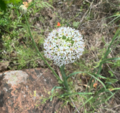 Allium canadense var. hyacinthoides


Allium canadense[edit]
Allium canadense, commonly known as the wild onion or Canada onion, is a perennial plant native to North America. It belongs to the Amaryllidaceae family, which includes other species such as Allium cepa (the common onion) and Allium sativum (garlic).
Description[edit]
Allium canadense is a herbaceous plant that typically grows to a height of 30 to 50 centimeters. The plant has a bulbous base, from which a single flowering stalk emerges. The leaves are long, narrow, and grass-like, growing from the base of the plant. The flowers are arranged in an umbel at the top of the stalk and are usually white or pink in color. Each flower has six tepals and six stamens.
Habitat[edit]
This species is commonly found in a variety of habitats, including meadows, prairies, and open woodlands. It prefers well-drained soils and can often be found in areas that receive full to partial sunlight. Allium canadense is native to a wide range of regions in North America, from Canada to the southern United States.
Ecology[edit]
Allium canadense plays a role in its ecosystem by providing food for various pollinators, including bees and butterflies. The plant's bulbs are also consumed by some wildlife, such as small mammals. Additionally, the plant can form dense colonies, which can help stabilize soil and prevent erosion.
Uses[edit]
Historically, Allium canadense has been used by indigenous peoples for both culinary and medicinal purposes. The bulbs and leaves can be eaten raw or cooked, and they have a flavor similar to that of cultivated onions. Medicinally, the plant has been used to treat a variety of ailments, although such uses are less common today.
Cultivation[edit]
Allium canadense can be cultivated in gardens, where it is valued for its ornamental flowers and its ability to attract pollinators. It is relatively easy to grow, requiring minimal maintenance once established. The plant can be propagated by dividing the bulbs or by sowing seeds.
