Allium amplectens: Difference between revisions
CSV import |
CSV import Tags: mobile edit mobile web edit |
||
| Line 4: | Line 4: | ||
File:CCDC82ExpressionData.png|Expression data for CCDC82 | File:CCDC82ExpressionData.png|Expression data for CCDC82 | ||
</gallery> | </gallery> | ||
==Allium amplectens== | |||
'''''Allium amplectens''''', commonly known as narrowleaf onion or clasping onion, is a species of [[perennial plant]] in the [[genus]] ''[[Allium]]''. It is native to the western regions of North America, particularly in the states of [[California]], [[Oregon]], and [[Washington (state)|Washington]]. | |||
==Description== | |||
''Allium amplectens'' is a [[herbaceous plant]] that grows from a [[bulb]] and is characterized by its narrow, linear leaves that clasp the stem. The plant typically reaches a height of 20 to 50 centimeters. The [[inflorescence]] is an [[umbel]] consisting of numerous small, star-shaped flowers that are usually white or pale pink in color. Each flower has six [[tepals]] and six [[stamens]]. | |||
The [[bulb]]s of ''Allium amplectens'' are ovoid and covered with a papery tunic. The leaves are basal, meaning they grow from the base of the plant, and are often shorter than the flowering stem. | |||
==Habitat and Distribution== | |||
''Allium amplectens'' is found in a variety of habitats, including [[grassland]]s, [[chaparral]], and [[woodland]]s. It is commonly found in areas with well-drained soils and can often be seen growing in rocky or sandy environments. The species is adapted to the Mediterranean climate of its native range, with wet winters and dry summers. | |||
==Ecology== | |||
The flowers of ''Allium amplectens'' are pollinated by a variety of insects, including [[bees]] and [[butterflies]]. The plant is an important part of the ecosystem, providing nectar and pollen for pollinators. The bulbs are also consumed by some [[rodents]] and other small mammals. | |||
==Uses== | |||
While not as widely used as some other species in the ''Allium'' genus, ''Allium amplectens'' has been used by indigenous peoples for its edible bulbs. The bulbs can be eaten raw or cooked and have a mild onion flavor. | |||
==Conservation== | |||
''Allium amplectens'' is not currently considered to be at risk, but like many native plants, it can be affected by habitat loss and competition from invasive species. Conservation efforts focus on preserving its natural habitats and promoting the growth of native plant communities. | |||
==Related pages== | |||
* [[Allium]] | |||
* [[Perennial plant]] | |||
* [[Pollination]] | |||
* [[Mediterranean climate]] | |||
{{Taxonbar|from=Q157303}} | |||
[[Category:Allium|amplectens]] | |||
[[Category:Flora of California]] | |||
[[Category:Flora of Oregon]] | |||
[[Category:Flora of Washington (state)]] | |||
Latest revision as of 00:35, 19 February 2025
-
 Allium amplectens flower close-up
 -
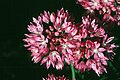 Allium amplectens in bloom
 -
 Expression data for CCDC82


Allium amplectens[edit]
Allium amplectens, commonly known as narrowleaf onion or clasping onion, is a species of perennial plant in the genus Allium. It is native to the western regions of North America, particularly in the states of California, Oregon, and Washington.
Description[edit]
Allium amplectens is a herbaceous plant that grows from a bulb and is characterized by its narrow, linear leaves that clasp the stem. The plant typically reaches a height of 20 to 50 centimeters. The inflorescence is an umbel consisting of numerous small, star-shaped flowers that are usually white or pale pink in color. Each flower has six tepals and six stamens.
The bulbs of Allium amplectens are ovoid and covered with a papery tunic. The leaves are basal, meaning they grow from the base of the plant, and are often shorter than the flowering stem.
Habitat and Distribution[edit]
Allium amplectens is found in a variety of habitats, including grasslands, chaparral, and woodlands. It is commonly found in areas with well-drained soils and can often be seen growing in rocky or sandy environments. The species is adapted to the Mediterranean climate of its native range, with wet winters and dry summers.
Ecology[edit]
The flowers of Allium amplectens are pollinated by a variety of insects, including bees and butterflies. The plant is an important part of the ecosystem, providing nectar and pollen for pollinators. The bulbs are also consumed by some rodents and other small mammals.
Uses[edit]
While not as widely used as some other species in the Allium genus, Allium amplectens has been used by indigenous peoples for its edible bulbs. The bulbs can be eaten raw or cooked and have a mild onion flavor.
Conservation[edit]
Allium amplectens is not currently considered to be at risk, but like many native plants, it can be affected by habitat loss and competition from invasive species. Conservation efforts focus on preserving its natural habitats and promoting the growth of native plant communities.
