Airway management: Difference between revisions
No edit summary |
CSV import |
||
| Line 81: | Line 81: | ||
[[Category:Emergency medicine]] | [[Category:Emergency medicine]] | ||
[[Category:Anesthesia]] | [[Category:Anesthesia]] | ||
<gallery caption="Airway management"> | |||
File:Glidescope_02.JPG|Airway management | |||
File:AbdominalThrust_HeimlichManoeuvre.jpg|Airway management | |||
File:Principe_heimlich_profil.svg|Airway management | |||
File:Tongue_blocking_airway.svg|Airway management | |||
File:Jaw_thrust_maneuver.jpg|Airway management | |||
File:Recovery_position.svg|Airway management | |||
File:Catheter_Introducing_Forceps_01.jpg|Airway management | |||
File:Oropharyngeal_Airways.jpg|Airway management | |||
File:Intubasion_boru.jpg|Airway management | |||
File:Larynx_external_en.svg|Airway management | |||
File:Tracheostomy_tube.jpg|Airway management | |||
File:Bagging.JPG|Airway management | |||
</gallery> | |||
Latest revision as of 12:03, 18 February 2025
Airway management

Airway management is a set of medical procedures performed to prevent and relieve airway obstruction. It ensures an open pathway for gas exchange between a patient's lungs and the atmosphere. Airway management is a critical skill in anesthesia, emergency medicine, intensive care, and first aid.
Techniques[edit]
Airway management techniques can be broadly categorized into non-invasive and invasive methods.
Non-invasive techniques[edit]
Non-invasive techniques are often the first line of intervention and include:
- Heimlich maneuver: A first aid procedure used to treat upper airway obstructions (or choking) by foreign objects. It involves a series of abdominal thrusts to expel the object.


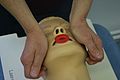
- Jaw-thrust maneuver: A technique used to open the airway by displacing the jaw forward without tilting the head. It is particularly useful in patients with suspected cervical spine injuries.

- Recovery position: A position used to maintain a clear airway in unconscious but breathing individuals. It involves placing the patient on their side with the head tilted back.

- Oropharyngeal airway: A device inserted into the mouth to prevent the tongue from obstructing the airway.

Invasive techniques[edit]
Invasive techniques are used when non-invasive methods are insufficient:
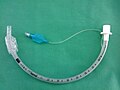
- Endotracheal intubation: The placement of a tube into the trachea to maintain an open airway. It is often performed using a laryngoscope or a Glidescope.

- Tracheostomy: A surgical procedure to create an opening in the neck to place a tube directly into the trachea.

Anatomy of the airway[edit]
Understanding the anatomy of the airway is crucial for effective management. The airway is divided into the upper and lower airways.
Upper airway[edit]
The upper airway includes the nasal cavity, oral cavity, pharynx, and larynx. The larynx is a critical structure that houses the vocal cords and is involved in protecting the airway during swallowing.

Lower airway[edit]
The lower airway consists of the trachea, bronchi, and lungs. The trachea is a tube that connects the larynx to the bronchi, allowing air passage to the lungs.
Complications[edit]
Complications in airway management can arise from improper technique or anatomical variations. Common issues include:
- Aspiration
- Hypoxia
- Trauma to the airway structures
Related pages[edit]
Gallery[edit]
-
 Diagram showing tongue blocking the airway
 -
 Catheter introducing forceps


- Airway management
-
 Airway management
 -
 Airway management
 -
 Airway management
 -
Airway management
-
 Airway management
 -
 Airway management
 -
Airway management
-
 Airway management
 -
 Airway management
 -
 Airway management
 -
 Airway management
 -
 Airway management

