Alaska pollock: Difference between revisions
CSV import |
CSV import |
||
| Line 60: | Line 60: | ||
[[Category:Fish of the Pacific Ocean]] | [[Category:Fish of the Pacific Ocean]] | ||
[[Category:Commercial fish]] | [[Category:Commercial fish]] | ||
== Alaska_pollock == | |||
<gallery> | |||
File:Theragra_chalcogramma.png|Alaska_pollock | |||
File:Alaska_Pollock_(Gadus_chalcogrammus)_-_GRB.jpg|Alaska_pollock | |||
File:Theragra_finnmarchica.jpg|Alaska_pollock | |||
File:Alaska_pollock(=walleye_poll.),_capture_production,_million_tonnes,_1950-2022.svg|Alaska_pollock | |||
File:Pollock_larva.jpg|Alaska_pollock | |||
File:Juvenile_pollock.jpg|Alaska_pollock | |||
File:Alaska_pollock_2.jpg|Alaska_pollock | |||
File:Alaska_pollock_catch.jpg|Alaska_pollock | |||
File:Japanese_Sugiyo_Kanikama_Kaoribako2.JPG|Alaska_pollock | |||
File:Alaska_pollock_roe_Russia.jpg|Alaska_pollock | |||
File:Hwangtae_(Gadus_chalcogrammus).jpg|Alaska_pollock | |||
</gallery> | |||
Latest revision as of 12:05, 18 February 2025
Species of fish
The Alaska pollock (Gadus chalcogrammus), also known as the walleye pollock, is a species of marine fish in the cod family Gadidae. It is a significant species in the North Pacific Ocean, known for its commercial importance in the fishing industry.
Description[edit]
The Alaska pollock is a medium-sized fish, typically reaching lengths of 30 to 50 cm. It has a slender body with a silvery coloration and a distinctive lateral line. The species is known for its three dorsal fins and two anal fins, which are characteristic of the Gadidae family.
Distribution and Habitat[edit]
Alaska pollock are found in the North Pacific Ocean, particularly in the Bering Sea and the Gulf of Alaska. They inhabit both pelagic and demersal zones, often found at depths ranging from 30 to 400 meters. The species is adapted to cold water environments and is a key component of the marine ecosystem in these regions.
Life Cycle[edit]
Alaska pollock spawn in late winter to early spring. The eggs are pelagic, and the larvae are planktonic, drifting with ocean currents. Juvenile pollock grow rapidly and reach maturity at around three to four years of age. The species has a lifespan of up to 15 years.
Diet[edit]
The diet of Alaska pollock consists primarily of zooplankton, small crustaceans, and other small fish. As they grow, they become more piscivorous, preying on smaller fish species.
Commercial Importance[edit]
Alaska pollock is one of the most important commercial fish species in the world. It is harvested primarily for its white flesh, which is used in a variety of products such as surimi, fish fillets, and fish sticks. The roe of Alaska pollock is also a valuable product, particularly in Japan.
Conservation and Management[edit]
The Alaska pollock fishery is one of the best-managed fisheries globally, with strict quotas and regulations to ensure sustainable harvests. The North Pacific Fishery Management Council oversees the management of the fishery, implementing measures to protect the stock and its habitat.
Culinary Uses[edit]
Alaska pollock is widely used in the production of surimi, a processed fish product that is often used to make imitation crab meat. It is also consumed as fillets and is a popular ingredient in fish and chips.
Related pages[edit]
Gallery[edit]
-
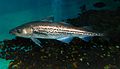 Alaska pollock in its natural habitat
 -
 Theragra finnmarchica
 -
 Capture production of Alaska pollock
 -
 Pollock larva
 -
 Juvenile pollock
 -
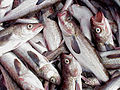 Alaska pollock
 -
 Alaska pollock catch
 -
 Japanese surimi product
 -
 Alaska pollock roe
 -
 Dried Alaska pollock (Hwangtae)
_-_GRB.jpg)

,_capture_production,_million_tonnes,_1950-2022.svg)


.jpg)
Alaska_pollock[edit]
-
 Alaska_pollock
 -
Alaska_pollock
-
Alaska_pollock
-
Alaska_pollock
-
Alaska_pollock
-
Alaska_pollock
-
Alaska_pollock
-
Alaska_pollock
-
Alaska_pollock
-
Alaska_pollock
-
Alaska_pollock

