Active mobility: Difference between revisions
CSV import |
CSV import |
||
| Line 64: | Line 64: | ||
[[Category:Public health]] | [[Category:Public health]] | ||
[[Category:Urban planning]] | [[Category:Urban planning]] | ||
<gallery> | |||
File:Cycliste_à_place_d'Italie-Paris_crop.jpg|Cyclist at Place d'Italie, Paris | |||
File:Bike_path_in_the_rain.jpg|Bike path in the rain | |||
File:Victoria_W6-V9-2.svg|Victoria W6-V9-2 | |||
File:Juist,_Carl-Stegmann-Straße_-_panoramio.jpg|Juist, Carl-Stegmann-Straße | |||
File:Cycling_Fatalities_in_the_Netherlands_Graph.png|Cycling Fatalities in the Netherlands Graph | |||
File:Bike_and_pedestrian_lanes_in_Roger_Williams_Park.jpg|Bike and pedestrian lanes in Roger Williams Park | |||
</gallery> | |||
Latest revision as of 10:54, 18 February 2025
Active mobility[edit]

Active mobility refers to modes of transportation that involve physical activity, primarily walking and cycling. It is a key component of sustainable urban planning and public health strategies, as it promotes physical activity, reduces traffic congestion, and decreases environmental pollution.
Types of Active Mobility[edit]
Walking[edit]
Walking is the most basic form of active mobility. It is accessible to most people and requires no special equipment. Walking is often integrated with other forms of transportation, such as public transit, to complete a journey.
Cycling[edit]

Cycling is another popular form of active mobility. It is faster than walking and can cover longer distances. Cycling infrastructure, such as bike lanes and bike-sharing systems, is crucial for promoting cycling in urban areas.
Benefits of Active Mobility[edit]
Health Benefits[edit]
Active mobility promotes physical activity, which is essential for maintaining a healthy lifestyle. Regular walking and cycling can reduce the risk of chronic diseases such as obesity, cardiovascular disease, and diabetes.
Environmental Benefits[edit]
Active mobility reduces reliance on motor vehicles, leading to lower emissions of greenhouse gases and air pollutants. This contributes to cleaner air and a reduction in urban heat islands.
Economic Benefits[edit]
Investing in active mobility infrastructure can lead to economic benefits by reducing healthcare costs, increasing productivity, and boosting local economies through increased foot traffic.
Challenges and Barriers[edit]
Infrastructure[edit]

The lack of adequate infrastructure is a significant barrier to active mobility. Safe and accessible sidewalks, bike lanes, and crossings are essential to encourage walking and cycling.
Safety[edit]
Safety concerns, such as traffic accidents and crime, can deter people from choosing active mobility. Improving safety through better infrastructure and public awareness campaigns is crucial.
Weather and Climate[edit]
Weather conditions can affect the feasibility of active mobility. Rain, snow, and extreme temperatures can discourage walking and cycling.
Promoting Active Mobility[edit]
Urban Planning[edit]
Integrating active mobility into urban planning involves designing cities that prioritize pedestrians and cyclists. This includes creating mixed-use developments, reducing car dependency, and enhancing public transit connections.
Policy and Legislation[edit]
Governments can promote active mobility through policies and legislation that support infrastructure development, provide incentives for active transportation, and implement safety regulations.
Community Engagement[edit]
Engaging communities in the planning and implementation of active mobility initiatives ensures that the needs and preferences of residents are considered, leading to more successful outcomes.
Related pages[edit]
Gallery[edit]
-
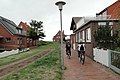 Pedestrian-friendly street
 -
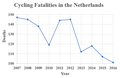 Graph of cycling fatalities in the Netherlands
 -
 Bike and pedestrian lanes


-
 Cyclist at Place d'Italie, Paris
 -
 Bike path in the rain
 -
 Victoria W6-V9-2
 -
Juist, Carl-Stegmann-Straße
-
Cycling Fatalities in the Netherlands Graph
-
Bike and pedestrian lanes in Roger Williams Park
