Aegle marmelos: Difference between revisions
CSV import |
CSV import |
||
| Line 54: | Line 54: | ||
[[Category:Flora of the Indian subcontinent]] | [[Category:Flora of the Indian subcontinent]] | ||
[[Category:Medicinal plants]] | [[Category:Medicinal plants]] | ||
== Aegle_marmelos == | |||
<gallery> | |||
File:Bael_(Aegle_marmelos)_tree_at_Narendrapur_W_IMG_4116.jpg|Bael tree at Narendrapur | |||
File:Trunks_and_leaves_of_Indian_bael_(Aegle_marmelos).jpg|Trunks and leaves of Indian bael | |||
File:Aikya_Linga_in_Varanasi.jpg|Aegle marmelos | |||
</gallery> | |||
Latest revision as of 04:11, 18 February 2025
Species of tree native to the Indian subcontinent and Southeast Asia
Aegle marmelos, commonly known as bael, is a species of tree native to the Indian subcontinent and Southeast Asia. It is a member of the family Rutaceae and is known for its medicinal properties and religious significance.
Description[edit]
Aegle marmelos is a medium-sized, deciduous tree that can grow up to 13 meters in height. The tree has a short trunk, thick bark, and spreading branches. The leaves are alternate, compound, and trifoliate, with each leaflet being ovate and having a pointed tip. The tree produces fragrant white flowers and a globose fruit with a hard, woody shell.
Distribution and habitat[edit]
The bael tree is native to the Indian subcontinent, including India, Nepal, Bangladesh, and Sri Lanka, and extends to Southeast Asia. It thrives in dry, open forests and is often found in areas with a hot, arid climate.
Uses[edit]
Medicinal uses[edit]
The fruit, leaves, and roots of Aegle marmelos have been used in traditional medicine for centuries. The fruit is known for its digestive properties and is used to treat diarrhea, dysentery, and other gastrointestinal disorders. The leaves are used in the treatment of diabetes and respiratory ailments.
Culinary uses[edit]
The ripe fruit of the bael tree is consumed fresh or dried. It is used to make beverages, jams, and sweets. The pulp is aromatic and has a sweet, tangy flavor.
Religious significance[edit]
The bael tree holds religious significance in Hinduism and Buddhism. The leaves are considered sacred and are often used in religious rituals and offerings. The tree is associated with Lord Shiva, and its leaves are used in the worship of the deity.
Cultivation[edit]
Aegle marmelos is cultivated for its fruit and medicinal properties. It is a hardy tree that can tolerate a wide range of soil types and climatic conditions. The tree is propagated through seeds, cuttings, or root suckers.
Gallery[edit]
-
 Bael tree
 -
 Trunks and leaves of Indian bael
 -
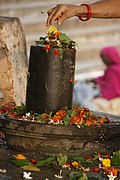 Aikya Linga in Varanasi
_tree_at_Narendrapur_W_IMG_4116.jpg)
.jpg)

Related pages[edit]
Aegle_marmelos[edit]
-
Bael tree at Narendrapur
-
Trunks and leaves of Indian bael
-
Aegle marmelos
