Abscisic acid: Difference between revisions
CSV import |
CSV import |
||
| Line 33: | Line 33: | ||
[[Category:Plant hormones]] | [[Category:Plant hormones]] | ||
<gallery> | |||
File:Abscisic_acid.svg|Chemical structure of Abscisic acid | |||
File:Xanthtoaba.svg|Biosynthesis pathway of Abscisic acid | |||
File:ABA_signal_cascade.jpg|Abscisic acid signal transduction cascade | |||
</gallery> | |||
Latest revision as of 01:06, 18 February 2025
REDIRECT Abscisic acid
Overview[edit]
Abscisic acid (ABA) is a plant hormone involved in many developmental processes and stress responses. It plays a crucial role in seed dormancy, stomatal closure, and plant stress responses.
Biosynthesis[edit]
Abscisic acid is synthesized in the chloroplasts of plant cells. The biosynthesis pathway involves the conversion of carotenoids into ABA through a series of enzymatic reactions. The key intermediate in this process is xanthoxin, which is converted into ABA through oxidation and other modifications.
Function[edit]
Abscisic acid is primarily known for its role in:
- Seed Dormancy: ABA helps maintain seed dormancy by inhibiting germination. It ensures that seeds only germinate under favorable conditions.
- Stomatal Closure: In response to drought stress, ABA induces the closure of stomata to reduce water loss through transpiration.
- Stress Response: ABA is involved in the plant's response to various abiotic stresses, such as drought, salinity, and cold.
Signal Transduction[edit]
The ABA signal transduction pathway involves several components, including receptors, secondary messengers, and transcription factors. The perception of ABA by its receptors leads to a cascade of events that ultimately result in physiological and developmental changes in the plant.
Related pages[edit]
Gallery[edit]
-
 Structure of Abscisic Acid
 -
 Biosynthesis pathway of Abscisic Acid
 -
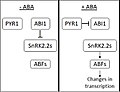 ABA Signal Transduction Pathway


-
Chemical structure of Abscisic acid
-
Biosynthesis pathway of Abscisic acid
-
Abscisic acid signal transduction cascade
