2017–2018 United States flu season: Difference between revisions
CSV import |
CSV import |
||
| Line 36: | Line 36: | ||
[[Category:2018 in the United States]] | [[Category:2018 in the United States]] | ||
[[Category:Health disasters in the United States]] | [[Category:Health disasters in the United States]] | ||
== 2017–2018 United States flu season == | |||
<gallery> | |||
File:Influenza_Cases_by_State_in_2017.png | |||
</gallery> | |||
Latest revision as of 00:22, 17 February 2025
Overview of the 2017–2018 flu season in the United States
The 2017–2018 United States flu season was one of the most severe in recent history, characterized by widespread influenza activity across the country. This season was notable for the high number of hospitalizations and the significant impact on public health systems.
Overview[edit]
The 2017–2018 flu season in the United States was marked by the predominance of the H3N2 strain of the influenza virus. This strain is known for causing more severe illness, particularly in older adults and young children. The season began earlier than usual, with widespread activity reported by the Centers for Disease Control and Prevention (CDC) as early as November 2017.
Epidemiology[edit]
The flu season saw a high number of influenza cases across all states. The CDC reported that the season was classified as "high severity" across all age groups. The hospitalization rates were among the highest recorded since the CDC began tracking this data.
Influenza Activity[edit]
Influenza activity was widespread across the United States, with all states reporting high levels of influenza-like illness (ILI) at some point during the season. The H3N2 strain was the most common, but there were also cases of H1N1 and influenza B viruses.
Impact on Healthcare[edit]
The high number of cases led to significant strain on healthcare systems, with many hospitals experiencing increased admissions and emergency room visits. The demand for antiviral drugs such as oseltamivir (Tamiflu) increased, and there were reports of shortages in some areas.
Public Health Response[edit]
The CDC and other public health organizations issued several advisories during the season, emphasizing the importance of influenza vaccination and the use of antiviral medications. Public health campaigns focused on increasing vaccination rates and educating the public about preventive measures such as hand hygiene and respiratory etiquette.
Vaccination[edit]
The effectiveness of the flu vaccine during the 2017–2018 season was lower than in previous years, particularly against the H3N2 strain. Despite this, vaccination was still recommended as it provided protection against other circulating strains and could reduce the severity of illness.
Related pages[edit]
Gallery[edit]
-
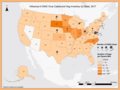 Influenza cases by state in 2017

