Iridium(V) fluoride: Difference between revisions
CSV import |
No edit summary |
||
| (One intermediate revision by the same user not shown) | |||
| Line 29: | Line 29: | ||
[[Category:Fluorides]] | [[Category:Fluorides]] | ||
[[Category:Chemical compounds]] | [[Category:Chemical compounds]] | ||
<gallery> | |||
File:PtF5solid.tif|PtF5 solid | |||
File:Unit cell of OsF5.png|Unit cell of OsF5 | |||
</gallery> | |||
Latest revision as of 00:03, 17 March 2025
Iridium(V) fluoride is a chemical compound with the formula IrF5. It is one of the higher fluorides of iridium, a transition metal in the platinum group of the periodic table. This compound is of interest in the field of inorganic chemistry due to its relatively rare oxidation state of +5 for iridium. Iridium(V) fluoride is involved in various chemical research areas, including the study of fluorination reactions and the synthesis of other iridium compounds.
Properties[edit]
Iridium(V) fluoride is a solid under standard conditions. It is characterized by its ability to act as a fluorinating agent, transferring fluoride ions to other substances. The compound is highly reactive, especially with water, and requires careful handling under inert atmospheres such as argon or nitrogen. The physical properties, such as melting point and boiling point, have not been thoroughly characterized due to the compound's reactivity and the difficulty in isolating pure samples.
Synthesis[edit]
The synthesis of IrF5 typically involves the direct reaction of iridium metal with elemental fluorine. This process requires high temperatures and the use of specialized apparatus to safely handle the reactive gases involved.
start
reaction
2 Ir + 5 F2 → 2 IrF5
end
Alternative synthetic routes may involve the fluorination of lower oxidation state iridium compounds, although these methods are less common and can introduce additional complexities in the purification of the final product.
Applications[edit]
The applications of iridium(V) fluoride are primarily confined to research settings. Its role as a fluorinating agent can be exploited in the synthesis of novel fluorine-containing compounds. Additionally, the study of its chemical properties contributes to a broader understanding of the chemistry of high oxidation state transition metal fluorides.
Safety[edit]
Iridium(V) fluoride, like many fluorides of transition metals, is highly reactive and potentially toxic. It can release toxic fluoride ions when in contact with moisture, leading to the formation of hydrofluoric acid. Proper safety precautions, including the use of appropriate personal protective equipment and ventilation, are essential when handling this compound.
See Also[edit]
-
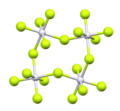 PtF5 solid
 -
 Unit cell of OsF5

