Piper auritum: Difference between revisions
CSV import |
No edit summary |
||
| (One intermediate revision by the same user not shown) | |||
| Line 25: | Line 25: | ||
{{botany-stub}} | {{botany-stub}} | ||
{{Mexico-stub}} | {{Mexico-stub}} | ||
<gallery> | |||
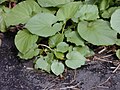
File:Starr_021122-0002_Piper_auritum.jpg|Piper auritum | |||
</gallery> | |||
Latest revision as of 00:57, 17 March 2025
Piper auritum, also known as Hoja santa, is a tropical plant species in the family Piperaceae. It is native to southern Mexico, Central America, and northern South America. The plant is recognized for its large, heart-shaped leaves and its distinctive aroma, which is often compared to anise or licorice.
Description[edit]
Piper auritum is a perennial herb that can grow up to 4 meters in height. The plant's leaves are its most distinctive feature, being large, heart-shaped, and often reaching up to 30 cm in length. The leaves are also known for their unique aroma, which is often compared to anise or licorice. The plant produces small, inconspicuous flowers in long, slender spikes, and its fruit is a small, spherical berry.
Cultivation and uses[edit]
Piper auritum is cultivated for its leaves, which are used in a variety of culinary and medicinal applications. In Mexican cuisine, the leaves are often used to wrap tamales, or used in the preparation of green sauces. The leaves are also used in traditional medicine for their supposed analgesic and anti-inflammatory properties.
Taxonomy[edit]
The species was first described by the Danish botanist William Hillebrand in 1853. It is a member of the genus Piper, which includes over 1,000 species of shrubs, herbs, and lianas, many of which are of economic importance.
See also[edit]
References[edit]
<references />


-
 Piper auritum

