Cinobufagin: Difference between revisions
CSV import |
No edit summary |
||
| (One intermediate revision by the same user not shown) | |||
| Line 45: | Line 45: | ||
[[Category:Steroids]] | [[Category:Steroids]] | ||
[[Category:Traditional Chinese medicine]] | [[Category:Traditional Chinese medicine]] | ||
<gallery> | |||
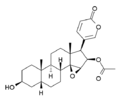
File:Cinobufagin.png|Cinobufagin | |||
</gallery> | |||
Latest revision as of 20:15, 16 March 2025
Cinobufagin[edit]
Cinobufagin is a bufadienolide compound found in the skin secretions of certain toads, particularly those of the genus Bufo. It is known for its potent cardiotonic and antineoplastic properties. This article provides an overview of the chemical structure, pharmacological effects, and potential therapeutic applications of cinobufagin.
Chemical Structure[edit]
Cinobufagin is a type of steroid with a molecular formula of C26H34O6. It is classified as a bufadienolide due to its characteristic lactone ring structure. The compound is structurally similar to other cardiac glycosides, such as digoxin, but differs in its specific configuration and functional groups.
Sources[edit]
Cinobufagin is primarily extracted from the skin and parotid gland secretions of toads belonging to the Bufo genus, such as Bufo bufo gargarizans and Bufo melanostictus. These secretions have been used in traditional Chinese medicine under the name "Chan Su" for their purported therapeutic effects.
Pharmacological Effects[edit]
Cinobufagin exhibits a range of pharmacological activities, including:
- Cardiotonic Effects: Cinobufagin acts on the sodium-potassium pump (Na⁺/K⁺-ATPase) in cardiac cells, leading to increased intracellular calcium levels. This enhances cardiac contractility, making it a potent cardiotonic agent.
- Antineoplastic Activity: Studies have shown that cinobufagin can induce apoptosis in various cancer cell lines, including hepatocellular carcinoma and lung cancer cells. It is believed to exert its antitumor effects through the modulation of signaling pathways such as PI3K/AKT and MAPK.
- Anti-inflammatory Effects: Cinobufagin has been reported to reduce inflammation by inhibiting the production of pro-inflammatory cytokines and mediators.
Therapeutic Applications[edit]
While cinobufagin has shown promise in preclinical studies, its clinical use is limited due to its narrow therapeutic index and potential toxicity. Research is ongoing to develop safer derivatives and formulations that can harness its therapeutic potential.
Traditional Medicine[edit]
In traditional Chinese medicine, cinobufagin-containing preparations are used for their purported benefits in treating heart failure, pain, and certain types of cancer. However, these uses are not widely accepted in Western medicine due to the lack of rigorous clinical trials.
Safety and Toxicity[edit]
Cinobufagin, like other cardiac glycosides, can be toxic at high doses. Symptoms of toxicity include nausea, vomiting, arrhythmias, and cardiac arrest. Careful dosing and monitoring are essential when using cinobufagin therapeutically.
Research and Development[edit]
Ongoing research aims to better understand the mechanisms of action of cinobufagin and to develop novel drug delivery systems that can improve its safety profile. Studies are also exploring its potential synergistic effects with other anticancer agents.
See Also[edit]
References[edit]
External Links[edit]
-
 Cinobufagin

