Transfer RNA: Difference between revisions
CSV import |
CSV import |
||
| Line 37: | Line 37: | ||
[[Category:RNA]] | [[Category:RNA]] | ||
[[Category:Protein biosynthesis]] | [[Category:Protein biosynthesis]] | ||
<gallery> | |||
File:Peptide_syn.svg|Peptide synthesis process | |||
File:TRNA-Phe_yeast_en.svg|Yeast tRNA-Phe structure | |||
File:TRNA-Phe_yeast_1ehz.png|Yeast tRNA-Phe 3D structure | |||
File:Trna.gif|Transfer RNA animation | |||
File:Transfer_RNA_morph_AT_to_PE_conformation.ogv|Transfer RNA morphing from AT to PE conformation | |||
File:Bulge-helix-bulge_BHB_tRNA_intron.png|Bulge-helix-bulge tRNA intron | |||
</gallery> | |||
Latest revision as of 11:01, 18 February 2025
Type of RNA molecule that helps decode a messenger RNA (mRNA) sequence into a protein
Transfer RNA (tRNA) is a type of RNA molecule that helps decode a messenger RNA (mRNA) sequence into a protein. tRNAs function at specific sites in the ribosome during translation, which is a process that synthesizes a protein from an mRNA molecule.
Structure[edit]

Transfer RNA molecules are typically 76 to 90 nucleotides in length and have a characteristic cloverleaf structure. This structure includes four arms: the acceptor stem, the T_C arm, the anticodon arm, and the D arm. The acceptor stem is where the amino acid is attached, while the anticodon arm contains the anticodon, a sequence of three nucleotides that is complementary to the mRNA codon.
Function[edit]

During protein synthesis, tRNA molecules transport specific amino acids to the ribosome, where they are added to the growing polypeptide chain. Each tRNA is specific to one amino acid and has an anticodon that pairs with the corresponding codon on the mRNA.
Aminoacylation[edit]
The process of attaching an amino acid to its corresponding tRNA is called aminoacylation. This reaction is catalyzed by enzymes known as aminoacyl tRNA synthetases. Each aminoacyl tRNA synthetase is specific for one amino acid and its corresponding tRNAs.
Role in Translation[edit]

In the ribosome, tRNA molecules align with mRNA codons through base pairing between the anticodon and the codon. This ensures that the correct amino acid is added to the polypeptide chain. The ribosome facilitates the formation of peptide bonds between adjacent amino acids, thus elongating the protein.
tRNA Genes[edit]

The genes encoding tRNA molecules are transcribed by RNA polymerase III in eukaryotes. These genes are often found in clusters in the genome and are transcribed as precursor molecules that are processed to form mature tRNAs.
Evolution[edit]
The structure and function of tRNA are highly conserved across all domains of life, indicating their ancient origin. The evolution of tRNA is closely linked to the evolution of the genetic code and the translation machinery.
Related pages[edit]
References[edit]
- Alberts, B., Johnson, A., Lewis, J., Raff, M., Roberts, K., & Walter, P. (2002). Molecular Biology of the Cell. 4th edition. New York: Garland Science.
- Lodish, H., Berk, A., Zipursky, S. L., Matsudaira, P., Baltimore, D., & Darnell, J. (2000). Molecular Cell Biology. 4th edition. New York: W. H. Freeman.
-
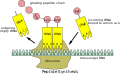 Peptide synthesis process
 -
 Yeast tRNA-Phe structure
 -
 Yeast tRNA-Phe 3D structure
 -
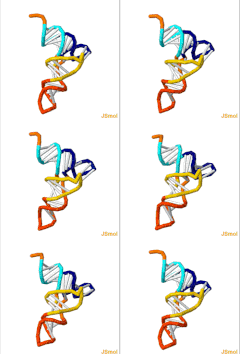 Transfer RNA animation
 -
 Transfer RNA morphing from AT to PE conformation
 -
 Bulge-helix-bulge tRNA intron

