Transglutaminase: Difference between revisions
CSV import |
CSV import Tags: mobile edit mobile web edit |
||
| Line 42: | Line 42: | ||
[[Category:Enzymes]] | [[Category:Enzymes]] | ||
[[Category:Food additives]] | [[Category:Food additives]] | ||
<gallery> | |||
File:Coagulation_factor_XIII_1EVU.png|Coagulation factor XIII structure | |||
File:Transamidation_and_deamidation_mechanisms_of_tissue_transglutaminase.jpg|Transamidation and deamidation mechanisms of tissue transglutaminase | |||
File:GluedBistroTenders.jpg|Transglutaminase | |||
File:ChickenSkinCrustedTerrine_(8302655857).jpg|Transglutaminase | |||
</gallery> | |||
Latest revision as of 04:38, 18 February 2025
Transglutaminase[edit]

Transglutaminase is an enzyme that catalyzes the formation of covalent bonds between proteins. It is widely distributed in nature and plays a crucial role in various biological processes, including blood clotting, skin formation, and wound healing.
Function[edit]
Transglutaminases catalyze the formation of an isopeptide bond between a free amine group and the gamma-carboxamide group of protein- or peptide-bound glutamine. This reaction is known as transamidation. The enzyme can also catalyze deamidation, where the amine group is replaced by water, releasing ammonia.

Types[edit]
There are several types of transglutaminases, including:
- Tissue transglutaminase (TG2): Involved in cell adhesion, apoptosis, and extracellular matrix formation.
- Coagulation factor XIII: Plays a key role in blood coagulation by stabilizing the fibrin clot.
- Epidermal transglutaminase: Important for skin barrier formation.
Applications[edit]
Transglutaminase is used in the food industry to improve the texture and appearance of products. It is often referred to as "meat glue" because it can bind proteins together, enhancing the quality of processed meats and other protein-rich foods.

Health Implications[edit]
While transglutaminase is generally considered safe for consumption, there are concerns about its potential role in celiac disease. Tissue transglutaminase is the autoantigen in celiac disease, and its activity can lead to the modification of gluten peptides, triggering an immune response in susceptible individuals.
Related pages[edit]
References[edit]
External links[edit]
.jpg)
-
 Coagulation factor XIII structure
 -
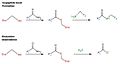 Transamidation and deamidation mechanisms of tissue transglutaminase
 -
 Transglutaminase
 -
 Transglutaminase
