Winfield Scott Hancock: Difference between revisions
No edit summary |
CSV import |
||
| Line 22: | Line 22: | ||
[[Category:1886 deaths]] | [[Category:1886 deaths]] | ||
{{US-military-bio-stub}} | {{US-military-bio-stub}} | ||
<gallery> | |||
File:Gen. Winfield S. Hancock - NARA - 529369 (cropped).jpg|Gen. Winfield S. Hancock | |||
File:Union Army major general rank insignia.svg|Union Army major general rank insignia | |||
File:Birthplace of Winfield Scott Hancock.jpg|Birthplace of Winfield Scott Hancock | |||
File:WScottHancock.jpg|W. Scott Hancock | |||
File:Major General Winfield Scott Hancock of General Staff U.S. Volunteers Infantry Regiment in uniform) - From photographic negative in Brady's National Portrait Gallery LCCN2016646210.jpg|Major General Winfield Scott Hancock of General Staff U.S. Volunteers Infantry Regiment in uniform | |||
File:Hancock, Gen. Winfield S. and staff (?) LCCN2013647706.jpg|Hancock, Gen. Winfield S. and staff | |||
File:Battle of Gettysburg LCCN2003663828.jpg|Battle of Gettysburg | |||
File:Hancock et al.png|Hancock et al. | |||
File:Execution Lincoln assassins.jpg|Execution Lincoln assassins | |||
File:Andrew Johnson.jpg|Andrew Johnson | |||
</gallery> | |||
Latest revision as of 05:32, 3 March 2025
Winfield Scott Hancock (February 14, 1824 – February 9, 1886) was a United States Army officer and the Democratic nominee for President of the United States in 1880. He served with distinction in the American Civil War, particularly during the Battle of Gettysburg where he played a critical role as a corps commander in the Union Army.
Early life and career[edit]
Born in Montgomery Square, Pennsylvania, Hancock graduated from the United States Military Academy at West Point in 1844. He served as a quartermaster during the Mexican-American War, but it was during the Civil War that he earned his reputation as a superb military leader.
Civil War service[edit]
Hancock's service in the Civil War was marked by notable leadership in several major battles. After being promoted to the rank of major general, he took command of the II Corps and led them in the Battle of Antietam, Battle of Fredericksburg, and the Battle of Chancellorsville. His leadership during the Battle of Gettysburg was particularly significant. On the second day of battle, he was instrumental in holding the Union line against a fierce Confederate assault. His actions earned him the nickname "Hancock the Superb."
Post-war career and 1880 presidential election[edit]
Following the war, Hancock was appointed as the military governor of Louisiana and Texas, where he sought to facilitate the Reconstruction process. In 1880, he ran for president as a Democrat but was narrowly defeated by James A. Garfield.
Death and legacy[edit]
Hancock died in 1886 at Governors Island, New York. He is remembered as one of the most respected leaders of the Union Army, and his leadership at Gettysburg remains widely studied in military circles.
See also[edit]
-
 Gen. Winfield S. Hancock
 -
 Union Army major general rank insignia
 -
 Birthplace of Winfield Scott Hancock
 -
 W. Scott Hancock
 -
 Major General Winfield Scott Hancock of General Staff U.S. Volunteers Infantry Regiment in uniform
 -
 Hancock, Gen. Winfield S. and staff
 -
 Battle of Gettysburg
 -
 Hancock et al.
 -
 Execution Lincoln assassins
 -
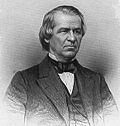 Andrew Johnson
.jpg)


_-_From_photographic_negative_in_Brady%27s_National_Portrait_Gallery_LCCN2016646210.jpg)
_LCCN2013647706.jpg)


