Hola Mohalla: Difference between revisions
CSV import |
CSV import |
||
| Line 38: | Line 38: | ||
[[Category:Festivals in Punjab, India]] | [[Category:Festivals in Punjab, India]] | ||
[[Category:Religious festivals in India]] | [[Category:Religious festivals in India]] | ||
<gallery> | |||
File:A_young_boy_practising,_Gatka,_SIkh_martial_art.jpg|A young boy practising Gatka, Sikh martial art | |||
File:Hola_Mohalla_Panjab_Digital_Library.jpg|Hola Mohalla Panjab Digital Library | |||
File:Hola_Mohalla_Holi_festival_and_sports,_Anandpur_Sahib_Punjab_India.jpg|Hola Mohalla Holi festival and sports, Anandpur Sahib Punjab India | |||
File:Group_of_Nihang_Singhs.jpg|Group of Nihang Singhs | |||
File:Sikhs_gathered_at_Hola_Mohalla_Holi_festival_in_Anandpur_Sahib.jpg|Sikhs gathered at Hola Mohalla Holi festival in Anandpur Sahib | |||
</gallery> | |||
Latest revision as of 11:25, 18 February 2025
Hola Mohalla
Hola Mohalla (Punjabi: ਹੋਲਾ ਮਹੱਲਾ) is a significant Sikh festival that takes place on the day following the Hindu festival of Holi. It is celebrated with great fervor and enthusiasm, primarily in the state of Punjab, particularly in the city of Anandpur Sahib. The festival was established by the tenth Sikh Guru, Guru Gobind Singh, as a day for Sikhs to demonstrate their martial skills and valor.
History[edit]
Hola Mohalla was initiated by Guru Gobind Singh in 1701 as a gathering of Sikhs for military exercises and mock battles. The word "Hola" is derived from "Holi," the Hindu festival of colors, while "Mohalla" refers to an organized procession. The festival was intended to be an occasion for Sikhs to reaffirm their commitment to the Khalsa Panth and to prepare for self-defense and community service.
Celebrations[edit]
The celebrations of Hola Mohalla last for three days and are marked by a variety of activities:
Martial Displays[edit]
Sikhs participate in displays of traditional martial arts known as Gatka, as well as other forms of combat training. These demonstrations are a reminder of the martial heritage of the Sikh community and their readiness to defend their faith and community.
Religious Observances[edit]
The festival includes religious ceremonies, kirtan (devotional singing), and recitations of Sikh scriptures. Pilgrims gather at Gurdwaras to offer prayers and listen to discourses on Sikh philosophy and history.
Processions[edit]
A key feature of Hola Mohalla is the grand procession that takes place, led by the Nihangs, the traditional Sikh warriors. The procession is a vibrant display of Sikh culture, with participants dressed in traditional attire, carrying weapons, and riding horses.
Community Service[edit]
Langar, the community kitchen, is an integral part of the festival, where free meals are served to all visitors, regardless of their background. This practice embodies the Sikh principles of equality and selfless service.
Significance[edit]
Hola Mohalla serves as a reminder of the martial and spiritual legacy of the Sikhs. It is a time for reflection on the teachings of the Gurus and the values of courage, discipline, and community service. The festival also fosters a sense of unity and solidarity among Sikhs.
Also see[edit]
| Sikhism | ||||||||||
|---|---|---|---|---|---|---|---|---|---|---|
|
-
 A young boy practising Gatka, Sikh martial art
 -
 Hola Mohalla Panjab Digital Library
 -
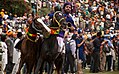 Hola Mohalla Holi festival and sports, Anandpur Sahib Punjab India
 -
 Group of Nihang Singhs
 -
 Sikhs gathered at Hola Mohalla Holi festival in Anandpur Sahib


