Color triangle: Difference between revisions
CSV import |
CSV import |
||
| Line 39: | Line 39: | ||
[[Category:Optics]] | [[Category:Optics]] | ||
[[Category:Artistic techniques]] | [[Category:Artistic techniques]] | ||
<gallery> | |||
File:Lichtenberg_color_triangle_Tobias_Mayer_1775.jpg|Lichtenberg Color Triangle by Tobias Mayer, 1775 | |||
File:CIExy1931_srgb_gamut.png|CIE 1931 xy Chromaticity Diagram with sRGB Gamut | |||
File:Color_top_1895.png|Color Top, 1895 | |||
File:YoungJamesClerkMaxwell.jpg|Young James Clerk Maxwell | |||
File:Maxwell_color_Triangle_Luckiesh_1921.png|Maxwell Color Triangle by Luckiesh, 1921 | |||
File:Fick_color_triangle.png|Fick Color Triangle | |||
</gallery> | |||
Latest revision as of 11:05, 18 February 2025
Color Triangle[edit]
A color triangle is a geometric representation of colors arranged in a triangular format, often used to illustrate the relationships between different colors. It is a tool used in color theory to help understand how colors interact with each other and how they can be mixed to create new colors. The concept of the color triangle is fundamental in the study of color theory and is used in various fields such as art, design, and optics.
History[edit]
The idea of organizing colors in a triangular format dates back to the 18th century. One of the earliest known color triangles was created by the German poet and philosopher Johann Wolfgang von Goethe in his work on color theory. Goethe's triangle was an attempt to categorize colors based on their psychological effects and their relationships to one another.
Structure[edit]
A typical color triangle consists of three primary colors at each vertex. These primary colors are usually red, blue, and yellow in the traditional color model. The sides of the triangle represent the mixtures of these primary colors, leading to the creation of secondary colors. The interior of the triangle can be filled with tertiary colors, which are mixtures of primary and secondary colors.
Types of Color Triangles[edit]
There are several types of color triangles, each based on different color models:
- RGB Color Triangle: This triangle is based on the RGB color model, which uses red, green, and blue as primary colors. It is commonly used in digital displays and electronic devices.
- RYB Color Triangle: This is the traditional artist's color triangle, using red, yellow, and blue as primary colors. It is often used in painting and art education.
- CMY Color Triangle: Based on the CMY color model, this triangle uses cyan, magenta, and yellow as primary colors. It is used in color printing and photography.
Applications[edit]
Color triangles are used in various applications, including:
- Art and Design: Artists and designers use color triangles to understand color harmony and to create visually appealing compositions.
- Education: Color triangles are used as educational tools to teach students about color mixing and the relationships between colors.
- Color Calibration: In technology, color triangles help in calibrating displays and printers to ensure accurate color reproduction.
Also see[edit]
-
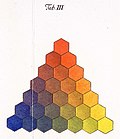 Lichtenberg Color Triangle by Tobias Mayer, 1775
 -
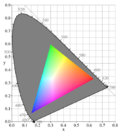 CIE 1931 xy Chromaticity Diagram with sRGB Gamut
 -
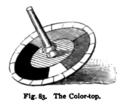 Color Top, 1895
 -
 Young James Clerk Maxwell
 -
 Maxwell Color Triangle by Luckiesh, 1921
 -
 Fick Color Triangle


