Asian palm civet: Difference between revisions
CSV import |
CSV import Tags: mobile edit mobile web edit |
||
| Line 41: | Line 41: | ||
[[Category:Mammals of Asia]] | [[Category:Mammals of Asia]] | ||
[[Category:Coffee production]] | [[Category:Coffee production]] | ||
== Asian_palm_civet == | |||
<gallery> | |||
File:Common_Palm_Civet_(Paradoxurus_hermaphroditus)_(7781509830).jpg|Common Palm Civet | |||
File:Himalay_Palm_Civet.jpg|Himalayan Palm Civet | |||
File:Paradoxureskull.png|Skull of a Palm Civet | |||
File:Asian_Palm_Civet_Over_A_Tree.jpg|Asian Palm Civet Over A Tree | |||
File:Asian_Palm_Civet_with_pups_Baranagar_Kolkata_West_Bengal_India.jpg|Asian Palm Civet with pups | |||
File:Paradox_hermaph_060924_ltn.jpg|Asian Palm Civet | |||
File:Luwak_(civet_cat)_in_cage.jpg|Luwak (civet cat) in cage | |||
File:Asianpalmcivetheads.png|Heads of Asian Palm Civets | |||
File:ParadoxurusHermaphroditusPhilippinensis01.jpg|Paradoxurus hermaphroditus philippinensis | |||
</gallery> | |||
Latest revision as of 12:22, 18 February 2025
The Asian palm civet (Paradoxurus hermaphroditus), also known as the toddy cat, is a small member of the family Viverridae native to South and Southeast Asia. It is known for its role in the production of kopi luwak, a type of coffee made using beans that have been eaten and excreted by the civet.
Description[edit]
The Asian palm civet is a small, nocturnal mammal with a body length of about 53 cm (21 in) and a tail that is roughly the same length. It has a coarse, shaggy coat that is typically grayish in color, with black markings on its face, feet, and tail. The civet's eyes are large and well-adapted for night vision, and it has a pointed snout and sharp teeth.
Habitat and Distribution[edit]
Asian palm civets are found in a variety of habitats, including forests, plantations, and urban areas. They are highly adaptable and can live in both primary and secondary forests, as well as in agricultural areas. Their range extends from the Indian subcontinent through Southeast Asia, including countries such as India, Sri Lanka, Myanmar, Thailand, Malaysia, Indonesia, and the Philippines.
Diet[edit]
The Asian palm civet is an omnivore, feeding on a wide range of foods. Its diet includes fruits, such as mangoes and bananas, as well as small mammals, insects, and other invertebrates. It is particularly fond of the fruit of the coffee plant, which it consumes and later excretes, leading to the production of kopi luwak coffee.
Behavior[edit]
Asian palm civets are solitary and nocturnal animals. They are arboreal, spending much of their time in trees, where they are agile climbers. During the day, they rest in tree hollows or other secluded spots. At night, they become active and forage for food.
Reproduction[edit]
The breeding season of the Asian palm civet varies depending on the region. Females typically give birth to litters of 2-4 young after a gestation period of about 60 days. The young are born blind and helpless, but they develop quickly and are weaned by the age of 2-3 months.
Conservation Status[edit]
The Asian palm civet is currently listed as Least Concern by the IUCN Red List due to its wide distribution and large population. However, it faces threats from habitat loss and hunting, particularly for the production of kopi luwak coffee. Conservation efforts are focused on habitat protection and sustainable coffee production practices.
Also see[edit]
Asian_palm_civet[edit]
-
 Common Palm Civet
 -
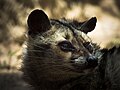 Himalayan Palm Civet
 -
 Skull of a Palm Civet
 -
 Asian Palm Civet Over A Tree
 -
 Asian Palm Civet with pups
 -
 Asian Palm Civet
 -
 Luwak (civet cat) in cage
 -
Heads of Asian Palm Civets
-
Paradoxurus hermaphroditus philippinensis
_(7781509830).jpg)


_in_cage.jpg)


