Flags of Europe: Difference between revisions
From WikiMD's Wellness Encyclopedia
CSV import |
CSV import |
||
| Line 59: | Line 59: | ||
[[Category:European culture]] | [[Category:European culture]] | ||
[[Category:Vexillology]] | [[Category:Vexillology]] | ||
<gallery> | |||
File:Map of Europe with flags.svg|Map of Europe with flags | |||
File:Flag of Benelux.svg|Flag of Benelux | |||
File:Flag of the Central Commission for Navigation on the Rhine.svg|Flag of the Central Commission for Navigation on the Rhine | |||
File:Commission centrale pour la navigation du Rhin - Drapeau.svg|Commission centrale pour la navigation du Rhin - Drapeau | |||
File:Flag of CEFTA.svg|Flag of CEFTA | |||
File:Flag of the CIS.svg|Flag of the CIS | |||
File:Flag of Europe.svg|Flag of Europe | |||
File:Flag of the European Parliament (1973-1983).svg|Flag of the European Parliament (1973-1983) | |||
File:Flag of the Nordic Council 2016.svg|Flag of the Nordic Council 2016 | |||
File:Flag of NATO.svg|Flag of NATO | |||
</gallery> | |||
Latest revision as of 05:54, 3 March 2025
Flags of Europe[edit]
The flags of Europe are a diverse collection of symbols that represent the countries, regions, and organizations within the continent. Each flag carries historical, cultural, and political significance, reflecting the identity and values of the entity it represents.
National Flags[edit]
Western Europe[edit]
- France: The French flag, known as the Tricolore, consists of three vertical bands of blue, white, and red. It was adopted in 1794 during the French Revolution and symbolizes liberty, equality, and fraternity.
- Germany: The German flag features three horizontal bands of black, red, and gold. These colors have been associated with German unity and freedom since the 19th century.
- United Kingdom: The Union Jack combines the crosses of St George (England), St Andrew (Scotland), and St Patrick (Ireland). It represents the union of these countries.
Northern Europe[edit]
- Sweden: The Swedish flag is a blue field with a yellow Scandinavian cross. The colors are derived from the national arms of Sweden.
- Norway: Norway's flag features a red field with a blue cross outlined in white. It was adopted in 1821 and reflects the country's historical ties with Denmark and Sweden.
Southern Europe[edit]
- Italy: The Italian flag consists of three vertical stripes of green, white, and red. It was inspired by the French Tricolore and adopted in 1946.
- Spain: Spain's flag has three horizontal stripes of red, yellow, and red, with the national coat of arms on the yellow stripe. It was adopted in 1785.
Eastern Europe[edit]
- Russia: The Russian flag is a tricolor of white, blue, and red horizontal stripes. It was first used in 1696 and re-adopted in 1991 after the dissolution of the Soviet Union.
- Poland: Poland's flag is a simple design of two horizontal stripes, white above red. These colors have been associated with Poland since the 13th century.
Regional and Supranational Flags[edit]
- European Union: The EU flag features a circle of 12 gold stars on a blue field. It symbolizes unity, solidarity, and harmony among the peoples of Europe.
- NATO: The NATO flag is dark blue with a white compass rose emblem, symbolizing the alliance's commitment to peace and security.
Historical Flags[edit]
Many European countries have historical flags that are no longer in official use but remain important cultural symbols.
- Austro-Hungarian Empire: The empire's flag was a black and yellow horizontal bicolor, representing the Habsburg monarchy.
- Soviet Union: The Soviet flag was red with a gold hammer and sickle and a gold-bordered red star in the upper canton.
See Also[edit]
References[edit]
- Smith, Whitney. Flags Through the Ages and Across the World. McGraw-Hill, 1975.
- Znamierowski, Alfred. The World Encyclopedia of Flags. Lorenz Books, 1999.
-
 Map of Europe with flags
 -
 Flag of Benelux
 -
 Flag of the Central Commission for Navigation on the Rhine
 -
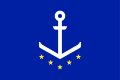 Commission centrale pour la navigation du Rhin - Drapeau
 -
 Flag of CEFTA
 -
 Flag of the CIS
 -
 Flag of Europe
 -
 Flag of the European Parliament (1973-1983)
 -
 Flag of the Nordic Council 2016
 -
 Flag of NATO


.svg)


