Phosphorus trichloride: Difference between revisions
CSV import |
CSV import Tags: mobile edit mobile web edit |
||
| Line 39: | Line 39: | ||
{{Chem-stub}} | {{Chem-stub}} | ||
<gallery> | |||
File:Phosphorus-trichloride-2D-dimensions.png|2D structure with dimensions of Phosphorus trichloride | |||
File:Phosphorus-trichloride-3D-vdW.png|3D van der Waals model of Phosphorus trichloride | |||
File:Phosphorus_trichloride_25ml.jpg|Phosphorus trichloride in a 25ml container | |||
</gallery> | |||
Latest revision as of 04:07, 18 February 2025
| Chemical Compound | |
|---|---|
| Identifiers | |
| CAS Number | |
| PubChem CID | |
| ChemSpider ID | |
| UNII | |
| ChEBI | |
| ChEMBL | |
| Properties | |
| Chemical Formula | |
| Molar Mass | |
| Appearance | |
| Density | |
| Melting Point | |
| Boiling Point | |
| Hazards | |
| GHS Pictograms | [[File:|50px]] |
| GHS Signal Word | |
| GHS Hazard Statements | |
| NFPA 704 | [[File:|50px]] |
| References | |
Phosphorus trichloride is a chemical compound formulated as PCl3. It is an important industrial chemical, primarily used in the manufacture of organophosphorus compounds for a wide range of applications including plasticizers, oil additives, and flame retardants.
Properties[edit]
Phosphorus trichloride is a colorless, fuming liquid with a pungent odor. It is highly reactive with water to release hydrogen chloride gas and heat, forming phosphorous acid:
PCl3 + 3 H2O → H3PO3 + 3 HCl
Due to its reactivity, it is typically stored under inert conditions and handled with strict safety precautions.
Production[edit]
Phosphorus trichloride is produced by the chlorination of white phosphorus along with the appropriate amount of chlorine. This reaction is exothermic and can be represented by the chemical equation:
P4 + 6 Cl2 → 4 PCl3
Applications[edit]
The primary use of phosphorus trichloride is in the production of other phosphorus compounds. It is a key precursor to phosphorus oxychloride (POCl3) and thiophosphoryl chloride (PSCl3), which are used in the production of pesticides and plasticizers. Additionally, PCl3 can be used to manufacture phosphonates, which are important in various applications including water treatment and metal surface treatment.
Safety[edit]
Phosphorus trichloride is highly toxic and corrosive. It can cause severe burns upon contact with skin and can be fatal if inhaled or ingested. Proper handling and storage are crucial to prevent accidents. It reacts violently with water, so it should not be exposed to moisture or stored in glass containers.
Environmental Impact[edit]
The production and use of phosphorus trichloride must be carefully managed to minimize environmental impact. Releases into the environment can lead to the formation of hydrochloric acid and phosphoric acid, both of which can have harmful effects on aquatic life and water quality.
Regulation[edit]
Due to its hazardous nature, phosphorus trichloride is subject to strict regulatory controls regarding its production, storage, transport, and disposal. These regulations ensure that the risks associated with phosphorus trichloride are managed effectively to protect human health and the environment.

-
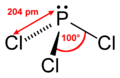 2D structure with dimensions of Phosphorus trichloride
 -
 3D van der Waals model of Phosphorus trichloride
 -
 Phosphorus trichloride in a 25ml container


