Presidency of Theodore Roosevelt: Difference between revisions
CSV import |
CSV import |
||
| (2 intermediate revisions by the same user not shown) | |||
| Line 1: | Line 1: | ||
The '''presidency of [[Theodore Roosevelt]]''' began on September 14, 1901, following the assassination of [[William McKinley]]. Roosevelt, a [[Republican Party (United States)|Republican]], became the youngest person to assume the U.S. presidency at the age of 42. His presidency ended on March 4, 1909. Roosevelt is known for his domestic policies, foreign policy, and his role in the [[Progressive Era]]. | |||
== Domestic Policies == | == Domestic Policies == | ||
Roosevelt's domestic policies were characterized by his | Roosevelt's domestic policies were characterized by his "[[Square Deal]]" program, which aimed to help middle-class citizens and involved attacking plutocracy and bad trusts while protecting business from the most extreme demands of organized labor. His policies included the [[Hepburn Act]], which gave the [[Interstate Commerce Commission]] the power to set maximum railroad rates, and the [[Pure Food and Drug Act]], which led to the creation of the [[Food and Drug Administration]]. | ||
=== Conservation === | === Conservation === | ||
Roosevelt was a | Roosevelt was a prominent advocate for the conservation of natural resources. He established the [[United States Forest Service]] and signed into law the creation of five national parks. He also signed the [[Antiquities Act]], which he used to proclaim 18 new [[National Monuments of the United States|national monuments]]. | ||
== | == Foreign Policy == | ||
Roosevelt's foreign policy was characterized by his motto, "[[Speak softly and carry a big stick]]". He was instrumental in negotiating the end of the [[Russo-Japanese War]], for which he won the [[Nobel Peace Prize]]. He also oversaw the construction of the [[Panama Canal]], which was a significant engineering feat and strategic asset for the United States. | |||
=== Roosevelt Corollary === | === Roosevelt Corollary === | ||
In 1904, Roosevelt articulated the [[Roosevelt Corollary]] to the [[Monroe Doctrine]], asserting | In 1904, Roosevelt articulated the [[Roosevelt Corollary]] to the [[Monroe Doctrine]], asserting the right of the United States to intervene in Latin America to stabilize the economic affairs of small states if they were unable to pay their international debts. | ||
== Legacy == | == Legacy == | ||
Roosevelt's presidency is | Roosevelt's presidency is considered a turning point in American history, as he expanded the influence and power of the executive office. His efforts in conservation, trust-busting, and foreign policy have left a lasting impact on the nation. | ||
== | == See also == | ||
* [[ | * [[Progressive Era]] | ||
* [[Square Deal]] | * [[Square Deal]] | ||
* [[Panama Canal]] | * [[Panama Canal]] | ||
* [[ | * [[Antiquities Act]] | ||
== | == References == | ||
[[Category:Presidency of Theodore Roosevelt]] | * [[Theodore Roosevelt Association]] | ||
[[Category: | * [[National Park Service]] | ||
{{DEFAULTSORT:Roosevelt, Theodore}} | |||
[[Category:Presidency of Theodore Roosevelt| ]] | |||
[[Category:1901 in the United States]] | |||
[[Category:1909 in the United States]] | |||
[[Category:Progressive Era in the United States]] | |||
[[Category:Republican Party (United States) politicians]] | [[Category:Republican Party (United States) politicians]] | ||
[[Category:Conservation in the United States]] | [[Category:Conservation in the United States]] | ||
{{nt}} | |||
<gallery> | |||
File:Theodore Roosevelt by the Pach Bros.jpg|Theodore Roosevelt by the Pach Bros | |||
File:TR Inaugurationsketch.jpg|TR Inauguration sketch | |||
File:Theodore Roosevelt outgoing cabinet.jpg|Theodore Roosevelt outgoing cabinet | |||
File:TR-Enviro.JPG|TR Enviro | |||
File:CoalBarons.JPG|Coal Barons | |||
File:TR-Farewell.JPG|TR Farewell | |||
File:American Colonies.png|American Colonies | |||
File:BigStick.jpg|Big Stick | |||
File:Tr-bigstick-cartoon.JPG|Tr bigstick cartoon | |||
File:Panama Canal under construction, 1907.jpg|Panama Canal under construction, 1907 | |||
</gallery> | |||
Latest revision as of 06:06, 3 March 2025
The presidency of Theodore Roosevelt began on September 14, 1901, following the assassination of William McKinley. Roosevelt, a Republican, became the youngest person to assume the U.S. presidency at the age of 42. His presidency ended on March 4, 1909. Roosevelt is known for his domestic policies, foreign policy, and his role in the Progressive Era.
Domestic Policies[edit]
Roosevelt's domestic policies were characterized by his "Square Deal" program, which aimed to help middle-class citizens and involved attacking plutocracy and bad trusts while protecting business from the most extreme demands of organized labor. His policies included the Hepburn Act, which gave the Interstate Commerce Commission the power to set maximum railroad rates, and the Pure Food and Drug Act, which led to the creation of the Food and Drug Administration.
Conservation[edit]
Roosevelt was a prominent advocate for the conservation of natural resources. He established the United States Forest Service and signed into law the creation of five national parks. He also signed the Antiquities Act, which he used to proclaim 18 new national monuments.
Foreign Policy[edit]
Roosevelt's foreign policy was characterized by his motto, "Speak softly and carry a big stick". He was instrumental in negotiating the end of the Russo-Japanese War, for which he won the Nobel Peace Prize. He also oversaw the construction of the Panama Canal, which was a significant engineering feat and strategic asset for the United States.
Roosevelt Corollary[edit]
In 1904, Roosevelt articulated the Roosevelt Corollary to the Monroe Doctrine, asserting the right of the United States to intervene in Latin America to stabilize the economic affairs of small states if they were unable to pay their international debts.
Legacy[edit]
Roosevelt's presidency is considered a turning point in American history, as he expanded the influence and power of the executive office. His efforts in conservation, trust-busting, and foreign policy have left a lasting impact on the nation.
See also[edit]
References[edit]
-
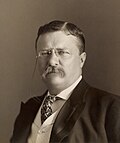 Theodore Roosevelt by the Pach Bros
 -
 TR Inauguration sketch
 -
 Theodore Roosevelt outgoing cabinet
 -
 TR Enviro
 -
 Coal Barons
 -
 TR Farewell
 -
 American Colonies
 -
 Big Stick
 -
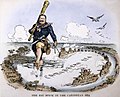 Tr bigstick cartoon
 -
 Panama Canal under construction, 1907


