Smalahove: Difference between revisions
CSV import |
CSV import |
||
| Line 33: | Line 33: | ||
{{Norway-stub}} | {{Norway-stub}} | ||
<gallery> | |||
File:Smalahove01.JPG|Smalahove dish | |||
File:Os_Game_Fair_2005.jpg|Os Game Fair 2005 | |||
</gallery> | |||
Latest revision as of 11:40, 25 February 2025

Smalahove is a traditional dish from Norway made from a sheep's head. It is typically associated with the region of Western Norway and is considered a delicacy, especially during the Christmas season.
Preparation[edit]
The preparation of smalahove involves several steps. First, the sheep's head is cleaned and the brain is removed. The head is then salted, sometimes smoked, and dried. Before cooking, it is soaked in water for about 24 hours to rehydrate it. The head is then boiled or steamed for about three hours until the meat is tender.
Serving[edit]
Smalahove is traditionally served with rutabaga (also known as swede) and potatoes. The meat from the head, including the cheeks and tongue, is considered the most delicious parts. The eyes are also eaten by some, although this is less common.
Cultural Significance[edit]
Smalahove has a long history in Norwegian cuisine and is often associated with rural and farming communities. It is particularly popular in the region of Voss, where it is often served during festive occasions. The dish is seen as a way to utilize all parts of the animal, reflecting the resourcefulness of traditional Norwegian farming practices.
Modern Context[edit]
In recent years, smalahove has gained attention from food enthusiasts and tourists looking to experience traditional Norwegian cuisine. Some restaurants in Norway now offer smalahove as part of their menu, especially during the winter months.
See Also[edit]
References[edit]
External Links[edit]


-
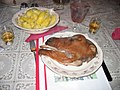 Smalahove dish
 -
 Os Game Fair 2005

