CD22: Difference between revisions
CSV import |
CSV import |
||
| Line 46: | Line 46: | ||
{{medicine-stub}} | {{medicine-stub}} | ||
== CD22 == | |||
<gallery> | |||
File:Microglial_cells.tif|Microglial cells | |||
File:Schematic_representation_of_the_CD22_and_B-cell_receptor_signalling_process.png|Schematic representation of the CD22 and B-cell receptor signalling process | |||
</gallery> | |||
Latest revision as of 21:44, 23 February 2025

Protein found in humans
CD22 (Cluster of Differentiation 22) is a protein that in humans is encoded by the CD22 gene. It is a member of the SIGLEC family of lectins and is primarily expressed on the surface of B cells. CD22 plays a crucial role in the regulation of the immune response.
Structure[edit]
CD22 is a type I transmembrane protein composed of an extracellular domain, a transmembrane domain, and a cytoplasmic tail. The extracellular domain contains multiple immunoglobulin-like domains, which are involved in binding to sialic acid-containing ligands. The cytoplasmic tail contains several tyrosine residues that become phosphorylated upon activation, serving as docking sites for SH2 domain-containing signaling molecules.
Function[edit]
CD22 functions as an inhibitory receptor for B cell receptor (BCR) signaling. Upon BCR engagement, CD22 becomes phosphorylated and recruits SHP-1, a tyrosine phosphatase, which dephosphorylates key signaling molecules, thereby dampening the BCR signal. This negative regulation is essential for maintaining B cell tolerance and preventing autoimmunity.
Expression[edit]
CD22 is expressed on the surface of mature B cells and is absent on plasma cells. It is also found in the cytoplasm of pro-B cells and pre-B cells but is not expressed on hematopoietic stem cells or other lymphoid or myeloid cells.
Clinical significance[edit]
CD22 is a target for therapeutic intervention in B cell-related diseases, such as non-Hodgkin lymphoma and chronic lymphocytic leukemia. Monoclonal antibodies and antibody-drug conjugates targeting CD22 have been developed and are used in the treatment of these malignancies.
Research[edit]
Research on CD22 continues to explore its role in B cell biology and its potential as a therapeutic target. Studies are also investigating the mechanisms by which CD22 regulates immune responses and its involvement in autoimmune diseases.
See also[edit]
References[edit]
<references group="" responsive="1"></references>

CD22[edit]
-
 Microglial cells
 -
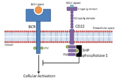 Schematic representation of the CD22 and B-cell receptor signalling process

