Olympic weightlifting: Difference between revisions
CSV import Tags: Manual revert mobile edit mobile web edit |
CSV import |
||
| Line 26: | Line 26: | ||
{{sports-stub}} | {{sports-stub}} | ||
<gallery> | |||
File:Kuo_Hsing-chun_at_her_final_round_in_2024_Summer_Olympics_2024-08-09.jpg|Kuo Hsing-chun at her final round in 2024 Summer Olympics | |||
File:Weightlifting_at_the_2016_Summer_Olympics_–_Men's_105_kg_7.jpg|Weightlifting at the 2016 Summer Olympics – Men's 105 kg | |||
File:Olympics_2012_Women's_75kg_Weightlifting.jpg|Olympics 2012 Women's 75kg Weightlifting | |||
File:RIAN_archive_484445_Winners_of_the_weightlifting_competition_in_the_1980_Olympics.jpg|Winners of the weightlifting competition in the 1980 Olympics | |||
File:Gewichtheben_Hantelstange_Detail.jpg|Olympic weightlifting | |||
File:Korea_London_Jang_Miran_03_(7771959092).jpg|Jang Mi-ran at the 2012 Olympics | |||
</gallery> | |||
Latest revision as of 11:33, 18 February 2025
Olympic weightlifting, often simply referred to as weightlifting, is a sport that tests participants' strength and technique in lifting weights. It is one of the oldest and most prestigious forms of strength competition, having been included in the Olympic Games since the inception of the modern Olympics in 1896. The sport is governed by the International Weightlifting Federation (IWF), which oversees the rules and regulations, equipment standards, and the organization of international competitions.
History[edit]
Olympic weightlifting has a rich history that dates back to the late 19th century. Initially, the sport included a variety of lifts, some of which are no longer practiced in modern competitions. Over the years, the format has evolved significantly. In the early days of the Olympic Games, weightlifting was not a standardized event and included a mixture of one-handed and two-handed lifts. By the mid-20th century, the sport had evolved into its current form, focusing on two main lifts: the snatch and the clean and jerk. These lifts require a combination of strength, speed, technique, and flexibility, making weightlifting a comprehensive test of physical ability.
Competition[edit]
In Olympic weightlifting competitions, athletes compete in two lifts: the snatch and the clean and jerk. Each competitor is allowed three attempts at each lift, and the best attempt at each lift is added together to determine the athlete's total score. Athletes are divided into weight classes to ensure fair competition, and medals are awarded in each weight class for the highest totals.
Snatch[edit]
The snatch is the first of the two Olympic weightlifting events. It is a single, continuous movement where the lifter lifts the barbell from the ground to overhead in one motion. This lift tests the athlete's ability to generate power and speed, as well as their technique and coordination.
Clean and Jerk[edit]
The clean and jerk is the second event in Olympic weightlifting. It is a two-part lift where the athlete first lifts the barbell to the shoulders (the clean) and then pushes it overhead (the jerk). This lift requires significant strength, especially in the legs and shoulders, as well as technical skill to execute both phases of the lift successfully.
Weight Classes[edit]
Weight classes are an essential aspect of Olympic weightlifting, ensuring that athletes compete against others of similar body weight. The IWF periodically reviews and adjusts the weight classes to reflect the changing demographics of the sport. As of the latest review, there are seven weight classes for men and seven for women in Olympic competition.
Training and Technique[edit]
Training for Olympic weightlifting involves a combination of strength training, technique drills, and flexibility exercises. Athletes must develop a strong foundation in basic strength exercises, such as squats and deadlifts, while also practicing the specific techniques of the snatch and clean and jerk. Flexibility, particularly in the hips, shoulders, and ankles, is crucial for executing the lifts with proper form.
International Competitions[edit]
The pinnacle of Olympic weightlifting is the Olympic Games, where the world's best athletes compete for gold medals in their weight classes. In addition to the Olympics, the IWF organizes the World Weightlifting Championships, a major annual event that attracts top lifters from around the globe. Regional competitions, such as the European, Asian, and Pan-American Championships, also play a significant role in the international weightlifting calendar.

-
 Kuo Hsing-chun at her final round in 2024 Summer Olympics
 -
 Weightlifting at the 2016 Summer Olympics – Men's 105 kg
 -
 Olympics 2012 Women's 75kg Weightlifting
 -
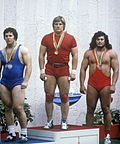 Winners of the weightlifting competition in the 1980 Olympics
 -
 Olympic weightlifting
 -
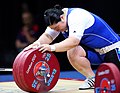 Jang Mi-ran at the 2012 Olympics


.jpg)
