Murder of John Lennon: Difference between revisions
CSV import |
CSV import |
||
| Line 26: | Line 26: | ||
[[Category:John Lennon]] | [[Category:John Lennon]] | ||
{{crime-stub}} | {{crime-stub}} | ||
<gallery> | |||
File:Police_artist_image_of_murder_of_John_Lennon.jpg|Police artist image of murder of John Lennon | |||
File:Annie_Leibovitz_Lennon_Ono_December_1980.jpg|Annie Leibovitz photo of Lennon and Ono, December 1980 | |||
File:1_West_72nd_Street_(The_Dakota)_entrance_by_David_Shankbone.jpg|Entrance of The Dakota, 1 West 72nd Street | |||
File:Dakota_Apartments_Entryway.jpg|Dakota Apartments Entryway | |||
File:Howard_cosell_1975.JPG|Howard Cosell, 1975 | |||
File:John_Lennon_-_Prag_-_1981.jpg|John Lennon - Prague - 1981 | |||
File:The_Imagine_Peace_Tower_on_Viðey_Iceland_near_Reykjavik_(4067485347).jpg|The Imagine Peace Tower on Viðey, Iceland near Reykjavik | |||
File:Strawberry_Fields_in_the_Central_Park_with_The_Dakota_behind.jpg|Strawberry Fields in Central Park with The Dakota behind | |||
</gallery> | |||
Latest revision as of 12:00, 18 February 2025
Murder of John Lennon
The murder of John Lennon occurred on December 8, 1980, outside the Dakota, his residence in New York City. Lennon, a world-renowned musician, best known as a member of the Beatles, was shot by Mark David Chapman, a fan who had earlier sought his autograph. The event marked the end of an era in music and had a profound impact on fans worldwide, leading to global mourning.
Background[edit]
John Lennon was an influential singer, songwriter, and peace activist. After the breakup of the Beatles in 1970, Lennon pursued a solo career and continued to use his fame to advocate for peace alongside his wife, Yoko Ono. By 1980, Lennon had returned to the music scene with the release of the album "Double Fantasy" after a five-year hiatus.
The Murder[edit]
On the evening of December 8, 1980, as Lennon and Ono returned to their apartment at the Dakota, Mark David Chapman approached Lennon and shot him four times in the back. Earlier that day, Chapman had met Lennon and had him sign a copy of "Double Fantasy." Chapman, who had flown to New York from Hawaii, had been loitering around the Dakota for several days. After the shooting, Chapman remained at the scene, reading J.D. Salinger's novel "The Catcher in the Rye," until he was arrested by the police.
Aftermath[edit]
John Lennon was pronounced dead on arrival at Roosevelt Hospital, leading to worldwide shock and mourning. The murder led to an outpouring of grief, with vigils and memorials held around the globe. Chapman pleaded guilty to second-degree murder and was sentenced to 20 years to life in prison. He has been denied parole multiple times.
The murder of John Lennon is often seen as a significant cultural and historical event, symbolizing the end of an era and the loss of a music icon who had used his platform to advocate for peace and change.
Impact[edit]
Lennon's death had a profound impact on music, culture, and the global peace movement. It prompted discussions on gun control, the cult of celebrity, and the vulnerabilities of public figures. Lennon's legacy, both as a member of the Beatles and as a solo artist, continues to influence music and culture.
See Also[edit]

-
Police artist image of murder of John Lennon
-
Annie Leibovitz photo of Lennon and Ono, December 1980
-
 Entrance of The Dakota, 1 West 72nd Street
 -
 Dakota Apartments Entryway
 -
 Howard Cosell, 1975
 -
 John Lennon - Prague - 1981
 -
 The Imagine Peace Tower on Viðey, Iceland near Reykjavik
 -
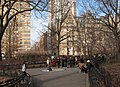 Strawberry Fields in Central Park with The Dakota behind
_entrance_by_David_Shankbone.jpg)


.jpg)


